

What if the intricate border of your living room rug isn't just a design, but a coded prayer for protection or a celebration of a forgotten spring? It's natural to feel a sense of quiet overwhelm when faced with the sheer complexity of traditional weaving. You might fear purchasing a piece without fully grasping its true heritage or struggle to find an authentic anchor that complements a modern luxury aesthetic. At JosmirLuxe, we believe that understanding Persian rug patterns and meanings is the key to transforming a beautiful room into a sanctuary of culture.
You already appreciate that a hand-knotted piece is more than a simple furnishing; it's a tangible asset that carries the weight of history. We'll show you how to read these woven manuscripts like fine art, allowing you to feel a deeper emotional connection to your home. This exploration covers the hidden vocabulary of iconic motifs and explains how these rare creations serve as both conversation starters and lasting heirlooms. By the end, you'll have the confidence to select a piece that reflects your personal narrative while elevating your physical space.
Key Takeaways
- Distinguish between the intricate symmetry of "City" rugs and the raw, geometric narratives of "Tribal" pieces to find your aesthetic match.
- Begin understanding Persian rug patterns and meanings to decode ancient symbols of eternity and protection woven into every fiber.
- Master the art of the foundational anchor by seamlessly blending heritage textiles with the clean lines of modern designer sectional sofas.
- View your selection as a curated legacy, moving beyond simple decor toward an investment-grade heirloom that defines your personal lifestyle.
The Silent Storyteller: Why Persian Rug Patterns Define a Space
Every hand-knotted rug acts as a unique expression of the weaver’s environment and aspirations. It’s a silent manuscript where every knot represents a moment in time. When you begin understanding Persian rug patterns and meanings, you realize these aren't just floor coverings. They're foundations for an elevated lifestyle. In a room filled with minimalist furniture, a Persian rug provides a necessary sense of history and warmth. When complemented by modern functional art from Artistry Deco Shop, it acts as a visual anchor, grounding the space and giving it a definitive character that mass-produced items simply can't replicate.
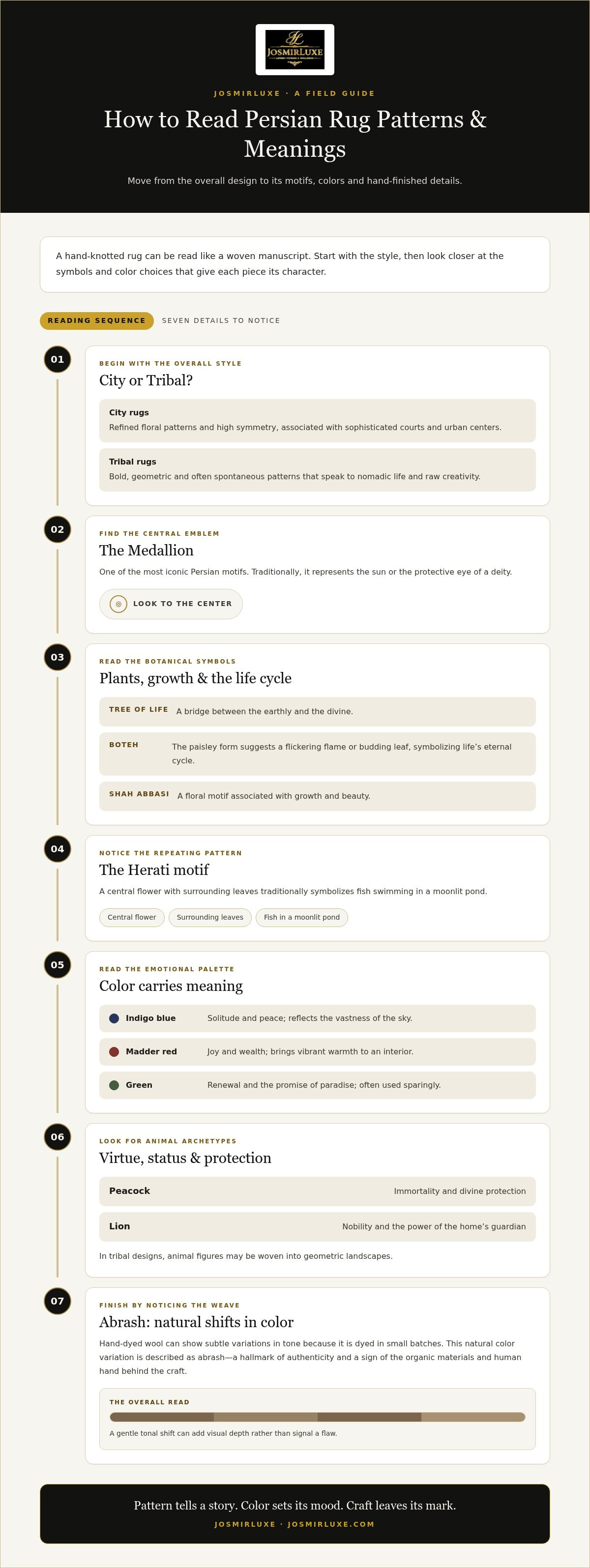
The distinction between styles is the first step in curation. City rugs are characterized by refined, floral, and highly symmetrical designs. They reflect the sophisticated courts and urban centers where they were commissioned. In contrast, Tribal rugs offer geometric, bold, and often spontaneous patterns that speak to nomadic life and raw creativity. Central to many of these designs is the Medallion, the most iconic Persian motif that traditionally represents the sun or the protective eye of a deity. Exploring the history of Persian carpets reveals how these symbols have evolved while maintaining their spiritual essence.
The Geometry of Heritage
City-woven patterns, particularly those from centers like Tabriz or Isfahan, are celebrated for their architectural precision. These designs are often drafted on paper before weaving begins, ensuring a level of detail that feels almost mathematical. However, even within this precision, you'll find "abrash." These natural color variations occur because the wool is hand-dyed in small batches. Rather than a flaw, abrash is a hallmark of authenticity. It proves the organic nature of the materials and the human hand behind the craft. This subtle shift in tone adds a layer of visual depth that complements the clean lines of modern designer sectional sofas, creating a balanced dialogue between heritage art and contemporary living.
Decoding the Language: Common Motifs and Their Meanings
Deepening your understanding Persian rug patterns and meanings requires looking beyond the surface to the intentions woven into every fiber. Each motif serves as a visual syllable in a much larger story. The Tree of Life is a universal pillar, acting as a bridge between the earthly and the divine. You'll often see the Boteh, or paisley, which represents a flickering flame or a budding leaf. Both symbolize life's eternal cycle. In more formal pieces, the Shah Abbasi floral motif reflects the opulence of ancient Persian courts, signifying growth and beauty. The Herati pattern is particularly evocative; its central flower and surrounding leaves traditionally symbolize fish swimming in a moonlit pond.
The Emotional Spectrum of Color
Colors carry an emotional weight that dictates a room's atmosphere. Indigo blue offers a sense of solitude and peace, reflecting the vastness of the sky. Madder red, derived from natural roots, pulses with the energy of joy and wealth. It provides a vibrant warmth to any interior. Green remains the most sacred hue. It represents renewal and the promise of paradise, often used sparingly to maintain its significance. These choices aren't accidental; they're deliberate attempts to influence the energy of a physical space.
Animals as Archetypes
Animals serve as archetypes of human virtue and status. The peacock stands for immortality and divine protection, adding a regal touch to the composition. The lion represents the nobility and power of the home's guardian. These tribal rug designs often blend these figures into geometric landscapes, creating a sense of movement and life. Selecting a piece with these symbols allows you to curate a narrative that resonates with your personal values. If you're ready to find a piece that speaks to your own journey, explore the collection at JosmirLuxe.
Curating Your Narrative: Integrating Heritage Art into Modern Living
The true art of interior design lies in the balance between ancient complexity and contemporary minimalism. Integrating a hand-knotted masterpiece into a modern home is an exercise in contrast and intention. Once you've mastered understanding Persian rug patterns and meanings, you can use these textiles as more than mere floor coverings. They become the soul of the room. A vibrant, intricate rug provides the perfect visual counterpoint to the clean, architectural lines of designer sectional sofas. This juxtaposition creates a space that feels curated rather than merely decorated, grounding your home in a narrative that spans centuries.
In open-concept luxury residences, pattern acts as a sophisticated tool for defining zones. A large medallion rug can anchor a grand dining salon, while a more subdued tribal design designates the boundaries of a private study. History shows that these pieces were always intended to command the energy of a room. For instance, The Ardabil Carpet demonstrates how scale and detail can define the atmosphere of a grand space. Choosing such a piece is also a commitment to conscious living. A hand-knotted rug is the ultimate sustainable choice for the conscious collector because its beauty is measured in centuries, not seasons.
The Modern Heirloom
Value often lies in the subtle nuances of the weave. The slight variations found in hand-knotted pieces aren't defects; they're the fingerprints of the artisan and marks of undeniable authenticity. These textures bring a sense of organic life to a home that factory-made items can't replicate. Consider the visual harmony created by pairing vintage wool textures with the cool, polished surface of luxury marble dining tables. It's a multi-layered aesthetic that speaks to a life well-lived and an eye for enduring quality. To find a piece that resonates with your personal story and elevates your daily environment, we invite you to explore the collection at JosmirLuxe.
Crafting a Legacy in Every Thread
By pairing these investment-grade heirlooms with contemporary staples, you create a sophisticated dialogue between the past and the present. Every piece at JosmirLuxe is selected for its exceptional craftsmanship and its ability to elevate the modern lifestyle. Whether you're defining an open-concept living area or seeking a focal point for a private study, the right rug serves as a lasting testament to quality and style. Explore the curated collection of hand-knotted Persian rugs at JosmirLuxe and begin the journey of transforming your home into a gallery of lived history.
Frequently Asked Questions
What is the most common symbol found in Persian rugs?
The Medallion is the most prevalent symbol, often positioned in the center to represent the sun or the all-seeing eye of a deity. It serves as the design's heart, with patterns flowing toward the borders like light or water. You'll also frequently encounter the Boteh, which symbolizes a flame or budding leaf, and the Herati motif, representing fish in a moonlit pond, all of which add layers of poetic meaning.
Can I use a traditional Persian rug in a modern, minimalist home?
A traditional hand-knotted piece acts as a sophisticated visual anchor in a minimalist interior. The intricate patterns provide a necessary contrast to clean, architectural lines, preventing a room from feeling too sterile. By understanding Persian rug patterns and meanings, you can select a design that complements your color palette while adding a layer of historical depth and organic texture to your modern space.
How do I know if the patterns on a rug are authentic or machine-made?
Authenticity is revealed on the underside of the rug. In a hand-knotted piece, the pattern is just as visible on the back as it is on the front, and individual knots will show slight, human irregularities. Machine-made rugs typically have a uniform, plastic-looking backing and a fringe that is sewn on rather than being an extension of the rug's own foundation threads. These subtle imperfections are hallmarks of a genuine heirloom.
Do different colors in a Persian rug change its meaning?
Color choices are never accidental; they're deliberate expressions of emotion and status. For instance, madder red traditionally symbolizes wealth and vibrant joy, while indigo blue represents solitude and the peaceful vastness of the sky. When you're understanding Persian rug patterns and meanings, you'll find that these hues work in tandem with the motifs to create a cohesive spiritual or cultural narrative. Each shade is chosen to influence the energy of your living environment.