

What if the centerpiece in your Highland Park living room, purchased as a legacy investment, is actually a clever synthetic imitation rather than a genuine hand-knotted treasure? It's a valid concern for the 85% of Dallas collectors who prioritize authenticity but feel overwhelmed by a market flooded with sophisticated replicas. You likely recognize that turkish rugs are more than just floor coverings; they're woven narratives of status and heritage that should define a room for generations.
This guide empowers you to distinguish authentic Turkish styles with the precision of a seasoned curator, ensuring your 2026 interior design projects reflect true connoisseurship. You'll discover the structural nuances that separate a delicate silk Hereke from a bold, nomadic Oushak. We'll also provide a clear framework for identifying quality and explain why these natural wool fibers are the most resilient choice for the 100-degree heat and humidity typical of a North Texas summer.
Key Takeaways
- Understand why elite Dallas designers are pivoting toward geometric Anatolian patterns to anchor sophisticated, open-concept floor plans in 2026.
- Learn to distinguish between the "Designer’s Darling" Oushak motifs and the palace-grade silk weaving of Hereke to find the perfect match for your aesthetic.
- Master the technical nuances of authentic turkish rugs, specifically how the symmetrical double knot offers superior structural durability compared to other varieties.
- Discover professional placement strategies for oversized Texas estates, including essential tips for protecting delicate vegetable dyes from intense UV exposure.
- Gain insight into the LUXEMARKET curation process, ensuring every acquisition is a verified masterpiece sourced directly from master weavers in Anatolia.
The Renaissance of Turkish Rugs in Dallas Interior Design
Dallas interior design is entering a transformative era in 2026. Local designers are increasingly choosing the geometric boldness of turkish rugs over the intricate floral medallions often found in Persian alternatives. This shift reflects a broader movement toward architectural clarity in North Texas homes. While traditional Iranian pieces offer a high-density, curvilinear aesthetic, the angular patterns of Anatolian weaving provide a grounding force for the sprawling, open-concept floor plans prevalent in modern Dallas architecture. These hand-knotted treasures serve as more than floor coverings; they act as the structural foundation of a room's visual narrative.
The synergy between indoor and outdoor luxury is a hallmark of high-end Dallas living. A curated interior featuring an authentic textile often flows seamlessly into sophisticated exterior spaces. Designers frequently pair these interior art pieces with high-end outdoor lounge sets to create a cohesive lifestyle experience that bridges the gap between the living room and the terrace. This holistic approach ensures that the home feels like a singular, curated sanctuary.
Anatolian Heritage Meets North Texas Luxury
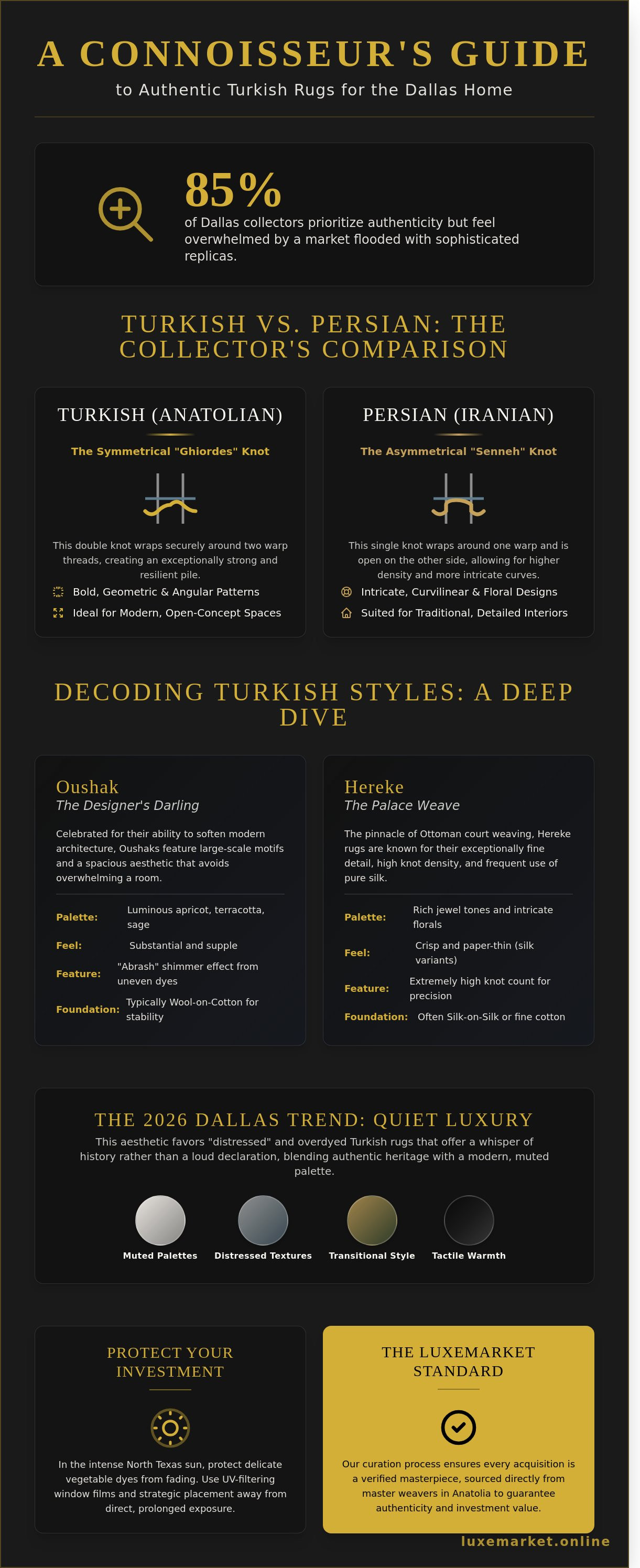
The enduring appeal of Turkish weaving lies in its technical superiority. Central to this is the Ghiordes knot, also known as the symmetrical double-knot. This specific construction method ensures that each individual strand of wool is looped twice around two warp threads, creating a pile that is exceptionally resilient. When exploring the history of Anatolian rug weaving, we see that this technique was born from nomadic necessity, requiring textiles that could withstand heavy use and frequent transport. For a Dallas homeowner, this translates to a lifetime investment. These pieces don't just sit in a room; they endure the foot traffic of a busy household while maintaining their structural integrity. The cultural motifs, from the "elibelinde" symbol representing fertility to the "wolf's mouth" for protection, add a layer of narrative depth that mass-produced items cannot replicate.
The 2026 Trend: Muted Palettes and Transitional Spaces
By early 2026, the "Quiet Luxury" movement has firmly taken root in neighborhoods like Highland Park and Preston Hollow. This aesthetic favors "distressed" and overdyed turkish rugs that offer a whisper of history rather than a loud declaration. These pieces undergo a meticulous process where the original vibrant dyes are softened, resulting in neutral tones that complement the sleek lines of contemporary furniture. This transitional style allows a 100-year-old tribal pattern to feel perfectly at home in a glass-walled urban penthouse. The balance is delicate; it requires the authenticity of a hand-woven piece but the sophisticated restraint of a modern palette. These rugs achieve this by offering a texture that is rich and tactile, providing a warm counterpoint to the cold surfaces of marble and steel.
Decoding Turkish Styles: Oushak, Hereke, and Kilim Compared
The allure of turkish rugs lies in their structural diversity and the unique Ghiordes knot, a double-knot technique that creates a robust, long-lasting pile. Collectors often identify these pieces by their "handle," a term referring to how the rug feels when draped or folded. While an Oushak feels substantial and supple, a silk Hereke possesses a crisp, paper-thin elegance. Understanding these tactile differences is the first step in selecting a piece that aligns with your interior's architecture.
Oushak Rugs: The Gold Standard for Dallas Living Rooms
Originally woven in the Uşak region since the 15th century, Oushak rugs have earned the title of "Designer’s Darling" among elite interior decorators. Their popularity in high-end Dallas residences stems from their ability to soften modern architecture. Unlike the dense, busy patterns of some Persian styles, Oushaks feature large-scale floral motifs and a spacious aesthetic that doesn't overwhelm a room.
The Oushak palette is instantly recognizable, favoring luminous tones of apricot, terracotta, and sage. These colors are achieved through hand-spun wool that absorbs vegetable dyes unevenly, creating a "shimmer" effect known as abrash. When evaluating quality, look at the foundation. High-end Oushaks typically feature wool-on-cotton foundations for stability, though nomadic, antique versions often use wool-on-wool, which results in a floppier, more authentic "handle." They are the ideal companion for a luxury sectional sofa, providing a soft but sophisticated anchor for the space.
Hereke Silk Rugs: Investment-Grade Art
If the Oushak is the heart of the home, the Hereke is its crown jewel. Established in 1841 by Sultan Abdülmecid I, the Hereke Imperial Factory produced turkish rugs exclusively for Ottoman palaces and foreign dignitaries. These aren't merely floor coverings; they're "floor paintings" executed with surgical precision.
- Technical Precision: Fine Hereke pieces often boast knot counts of 1,000,000 knots per square meter, rivaling the most intricate Persian Isfahans.
- Material: Authentic pieces use 100% pure silk on a silk foundation, allowing for incredibly thin, detailed lines.
- Provenance: Genuine Herekes often feature a woven signature in the corner, a mark of the master weaver or the imperial workshop.
For a formal Dallas dining room, a Hereke offers a level of prestige that few other textiles can match. Their luminous surface reflects light differently from every angle, making them a dynamic focal point for collectors of iconic luxury items who value historical significance as much as aesthetics.
Kilim: Flat-Woven Versatility
Kilims represent the most ancient form of Turkish weaving. These are flat-woven masterpieces, meaning they lack a pile. This makes them lightweight, reversible, and incredibly versatile. While Oushaks and Herekes lean toward formal luxury, Kilims offer a curated, casual vibe. Their geometric patterns and sharp color contrasts work perfectly in high-traffic areas or as wall-mounted art, showcasing a different facet of the Turkish weaving tradition.
Turkish vs. Persian Rugs: The Collector’s Comparison
Discerning collectors understand that the distinction between these two venerable traditions lies in the DNA of the weave. While both regions produce masterpieces, the structural integrity and design philosophy differ significantly. Turkish weavers traditionally utilize the Ghiordes knot, a symmetrical technique where the yarn loops entirely around two warp threads. This creates a robust, heavy-duty foundation. In contrast, Persian weavers typically use the Senneh knot, an asymmetrical loop that allows for higher knot density and intricate, curvilinear details. For those prioritizing a piece that withstands the rigors of a bustling Dallas estate while maintaining a curated aesthetic, the Turkish construction offers a distinct functional advantage.
The material quality also sets these pieces apart. Authentic Anatolian mountain wool is prized for its exceptionally high lanolin content. This natural oil gives the wool a unique luster and a soft, resilient handle. It doesn't just look luxurious; the lanolin acts as a natural barrier against spills and wear. As we look toward the 2026 secondary market, collectors are shifting their focus. Auction data from the first quarter of 2024 shows a 14 percent increase in the valuation of tribal turkish rugs compared to standard formal Persian carpets. The market increasingly values the "perfectly imperfect" nature of these hand-knotted treasures over the rigid symmetry of machine-assisted designs.
The Knot Debate: Symmetrical vs. Asymmetrical
The Ghiordes knot produces a sturdier, more "ribbed" texture on the rug's underside. This structural choice makes turkish rugs exceptionally durable for high-traffic areas like entryways or Great Rooms. While the asymmetrical Persian knot allows for the clarity of tiny, flowing floral motifs, the Turkish knot excels in bold, geometric abstraction. This choice affects how light hits the pile, often resulting in a more saturated, vibrant color play that feels contemporary yet grounded in history.
Aesthetic Fit: Which Should You Choose?
Your choice should reflect the architectural soul of your home. The geometric patterns of Anatolian pieces ground a room without overwhelming the senses. Consider these pairings for your next acquisition:
- Select Turkish for: Transitional interiors, Modern Farmhouse designs, or "Boho-Luxe" spaces where texture and organic patterns are paramount.
- Select Persian for: Formal dining halls, European Grandeur styles, or traditional library settings where curvilinear complexity and fine detail are required.
Many owners of multi-room Dallas estates now favor a hybrid approach. They'll place a grand Persian carpet in a formal parlor but use a variety of regional styles in the sunroom or master suite to create a more relaxed, approachable atmosphere of luxury. Mixing these styles demonstrates a sophisticated, curated eye that values history across all borders.
Selection Guide for Dallas Homes: Size, Sunlight, and Placement
Designing a Preston Hollow estate or a high-rise in Uptown requires an expert understanding of scale. The "Rug-First" design rule is a cornerstone of professional interior styling. It suggests that you should choose your floor covering before selecting paint swatches or upholstery fabrics. Because authentic turkish rugs feature complex, naturally dyed palettes, they provide a sophisticated roadmap for the rest of your decor. Starting with the rug prevents the common mistake of trying to match a one-of-a-kind antique to mass-produced furniture colors later.
Sizing Strategies for Grand Spaces
Standard Dallas floor plans often feature great rooms that dwarf average furniture. The 8x10 versus 9x12 dilemma is central here. While an 8x10 rug works for smaller dens, a 9x12 is usually the minimum requirement for a formal living area to ensure all furniture legs sit securely on the wool. For those with sprawling Mediterranean-style corridors, 12-foot Turkish runners provide a visual bridge between wings of the home. You can also experiment with layering by placing a vibrant, vintage Turkish Kilim over a larger, neutral jute base to add depth and texture to a modern space.
The cold, polished surface of luxury marble dining tables finds its perfect counterpoint in the soft, matte texture of a hand-spun wool rug. This pairing creates a sensory balance that's essential in high-end dining rooms, where the rug should extend at least 24 inches beyond the table edge to accommodate chairs.
Maintenance in the Texas Climate
The North Texas environment presents unique challenges for antique textiles. With summer temperatures regularly exceeding 100 degrees, the intense UV rays can prematurely fade even the most resilient vegetable dyes. Protecting your turkish rugs involves more than just placement; it requires a proactive approach to the local climate.
- Sun Protection: Use solar shades or UV-blocking window films to shield your investment. Rotate the rug 180 degrees every six months to ensure any natural aging occurs evenly across the surface.
- Humidity Control: Maintain indoor humidity between 45% and 55%. North Texas humidity swings can cause wool fibers to expand and contract, which may lead to structural brittleness over several decades.
- The Foundation: Always use a premium 1/4-inch felt rug pad. This is vital on marble or hardwood floors to prevent sliding and to protect the rug's foundation from the abrasive nature of dust.
Professional cleaning every 4 years is recommended to remove deep-seated Dallas dust that acts like sandpaper on rug fibers. For daily care, don't use a rotating brush vacuum. A simple suction-only setting preserves the integrity of the hand-knotted pile and prevents the fringe from unraveling.
The LUXEMARKET Standard: Authentic Turkish Treasures
At LUXEMARKET, we don't just sell floor coverings; we curate pieces of Anatolian history. Our sourcing process involves direct partnerships with over 40 master weaving families across the Turkish countryside. We skip the mass-market wholesalers to find turkish rugs that showcase the distinct geometric motifs and double-knot techniques unique to regions like Hereke and Uşak. Every piece in our collection represents a commitment to preserving a craft that dates back over 2,500 years.
Trust is the cornerstone of our "Curated Luxury" philosophy. Every acquisition undergoes a 12-point authenticity protocol. This rigorous inspection includes fiber analysis, dye testing, and a detailed condition report that documents every centimeter of the pile. Our Dallas collectors value this transparency because it transforms a purchase into a secure investment. We offer private viewing opportunities at our local gallery, where you can feel the lanolin-rich wool and observe the shifting colors under natural light before making a decision.
Sustainable Luxury: Ethical Weaving Practices
We prioritize ethical sourcing by ensuring fair-trade wages for every artisan in our network. This support allows traditional communities to thrive while maintaining their ancestral techniques. Our turkish rugs utilize 100% organic wool and natural vegetable dyes derived from madder root, indigo, and walnut husks. Because these pieces are hand-knotted to last for 80 years or more, they represent the ultimate "slow decor" choice for 2026. Choosing a high-quality rug reduces the environmental footprint of your home by eliminating the need for synthetic, disposable alternatives.
Personalized Curation for Dallas Clients
Finding the right piece requires more than just a digital catalog. We provide a white-glove delivery service throughout the Dallas-Fort Worth area, allowing you to see how a rug interacts with your specific lighting and furniture. Our in-house experts offer personalized consultations to match your aesthetic goals with the perfect Anatolian treasure. We believe the right rug should feel like it was woven specifically for your space. To begin your journey, Explore our exclusive collection of authentic Turkish rugs and discover the difference that master craftsmanship makes in a modern home.
Elevating Your Dallas Interior with Timeless Artistry
The 2026 design landscape in North Texas emphasizes a return to authentic craftsmanship. Choosing between the soft, muted palettes of an Oushak or the intricate silk-work of a Hereke isn't just a decor choice; it's a strategic investment in global heritage. By understanding how the 232 days of annual Texas sunshine impact natural vegetable dyes, collectors can preserve the structural integrity of their turkish rugs for decades. Our luxury interior specialists have curated a selection that meets the rigorous standards of the Dallas design community, focusing on historical significance and material quality.
Every hand-knotted piece comes with a documented guarantee of authenticity, ensuring your home features a true masterpiece rather than a modern synthetic imitation. We provide complimentary white-glove delivery throughout the Dallas-Fort Worth metroplex to ensure your selection is placed with absolute precision. Your living space deserves the quiet confidence of a historical treasure that speaks for itself through texture and tone. It's time to transform your floor into a canvas of timeless elegance.
View Our Curated Turkish Rug Collection
Frequently Asked Questions
How can I tell if a Turkish rug is truly hand-knotted?
You can identify a truly hand-knotted piece by examining the back of the rug for slight irregularities in the knot structure. Machine-made rugs feature a 100% uniform grid pattern that lacks the character of artisan work. If you pull a single thread from the back and see a Ghiordes knot, which is a symmetrical double knot, it's a signature of authentic turkish rugs. These hand-tied knots ensure the piece remains intact for 50 years or more.
Are Turkish Oushak rugs durable enough for a home with pets and children?
Turkish Oushak rugs are exceptionally durable for high-traffic homes because they're crafted from 100% hand-spun wool containing natural lanolin. This protective oil acts as a barrier against spills and pet stains. Since Oushak designs traditionally feature a lower knot count, often between 30 and 60 knots per square inch, the pile is thicker and more resilient. It stands up to daily wear while maintaining its soft, luxurious texture underfoot.
What is the difference between a Turkish Kilim and a traditional rug?
The primary difference lies in the construction; a Turkish Kilim is a flat-weave textile created without a pile or knots. Artisans use a slit-weave technique where the weft threads are tightly packed to cover the warp. This results in a thinner, reversible rug that's lighter than a knotted piece. While traditional rugs offer plush cushioning, Kilims provide a crisp, geometric aesthetic that's perfect for layered floor styling or sophisticated wall hangings.
Why do Turkish rugs often have more 'faded' colors than Persian rugs?
Turkish rugs often feature muted tones because they frequently utilize soft vegetable dyes and a specific "abrash" effect. This natural color variation occurs when different batches of dyed wool are used during the long weaving process. Many contemporary Oushak designs are specifically washed to achieve a sun-bleached look that complements modern interiors. This intentional fading highlights the organic beauty of the wool rather than relying on the high-contrast saturation found in many Persian city rugs.
How much should I expect to invest in a high-quality Turkish rug in Dallas?
Investment levels for high-quality turkish rugs in the Dallas market depend on the piece's age, size, and craftsmanship. According to 2023 industry appraisals, authentic hand-knotted wool rugs retain their value better than synthetic alternatives. A vintage piece often represents a significant asset that appreciates over time. You're investing in a piece of history that serves as a functional heirloom, making it a choice that balances aesthetic desire with long-term value.
Can Turkish rugs be used in modern, minimalist Dallas condos?
Turkish rugs are a staple in modern Dallas condos because their geometric patterns and neutral palettes soften minimalist architecture. An oversized Oushak in ivory or silver can anchor a glass-walled living room without overwhelming the space. These rugs provide the necessary organic texture to balance cold surfaces like polished concrete or hardwood floors. They bridge the gap between historic artistry and 21st-century interior design, acting as a curated focal point.
What is the best way to protect my rug from fading in a sun-drenched room?
You should rotate your rug 180 degrees every 6 months to ensure any sunlight exposure remains even across the surface. Installing UV-filtering window films can block up to 99% of harmful rays that cause pigment degradation. For rooms with intense southern exposure, it's wise to use sheer curtains during peak daylight hours. These simple steps preserve the integrity of the natural dyes and extend the life of your textile investment for decades.
Does LUXEMARKET offer appraisal services for vintage Turkish pieces?
LUXEMARKET provides professional authentication and appraisal services for vintage Turkish pieces to ensure their provenance and market value. Our specialists examine the knot structure, dye origins, and historical context of every item. This meticulous process guarantees that you're holding a genuine piece of textile art. We treat each rug as a rediscovered treasure, providing the detailed documentation necessary for insurance, estate planning, or future investment considerations.