

What if the most sophisticated choice for your legacy isn't defined by the millennia a stone spent underground, but by the conscious innovation of the present? You likely appreciate the weight of tradition and the sparkle of a gem that tells a story, yet you're hearing conflicting whispers about what truly constitutes a "real" diamond. It's natural to feel a sense of hesitation when deciding between lab grown vs natural diamonds, especially when seeking a piece that reflects your commitment to an elevated lifestyle. You want a stone that carries a soul, whether it's born from the earth's depths or human ingenuity.
We promise to help you look past the confusing terminology to choose the gemstone that best aligns with your aesthetic values and the curated atmosphere of your life. You'll gain a clear understanding of the value proposition in 2026 and see why sustainability has become a new hallmark of true luxury. We'll explore the identical brilliance of these gems and how JOSMIRLUXE views the evolution of the modern heirloom. This journey ensures you feel complete confidence that your choice is as authentic as the life you've built.
Key Takeaways
- Understand the scientific reality that lab-grown diamonds possess the exact same chemical and physical properties as those found in nature.
- Learn how the choice between lab grown vs natural diamonds empowers you to prioritize visual impact and brilliance in your personal style.
- Discover why modern lab-grown techniques often yield superior clarity and color, meeting the most discerning standards of high-end jewelry.
- Explore how selecting sustainable gemstones has become a defining hallmark of the conscious, modern luxury lifestyle.
- Gain the clarity needed to select a piece that reflects your unique story, whether it's rooted in geological history or human innovation.
The Evolution of Brilliance: Redefining the Diamond Standard
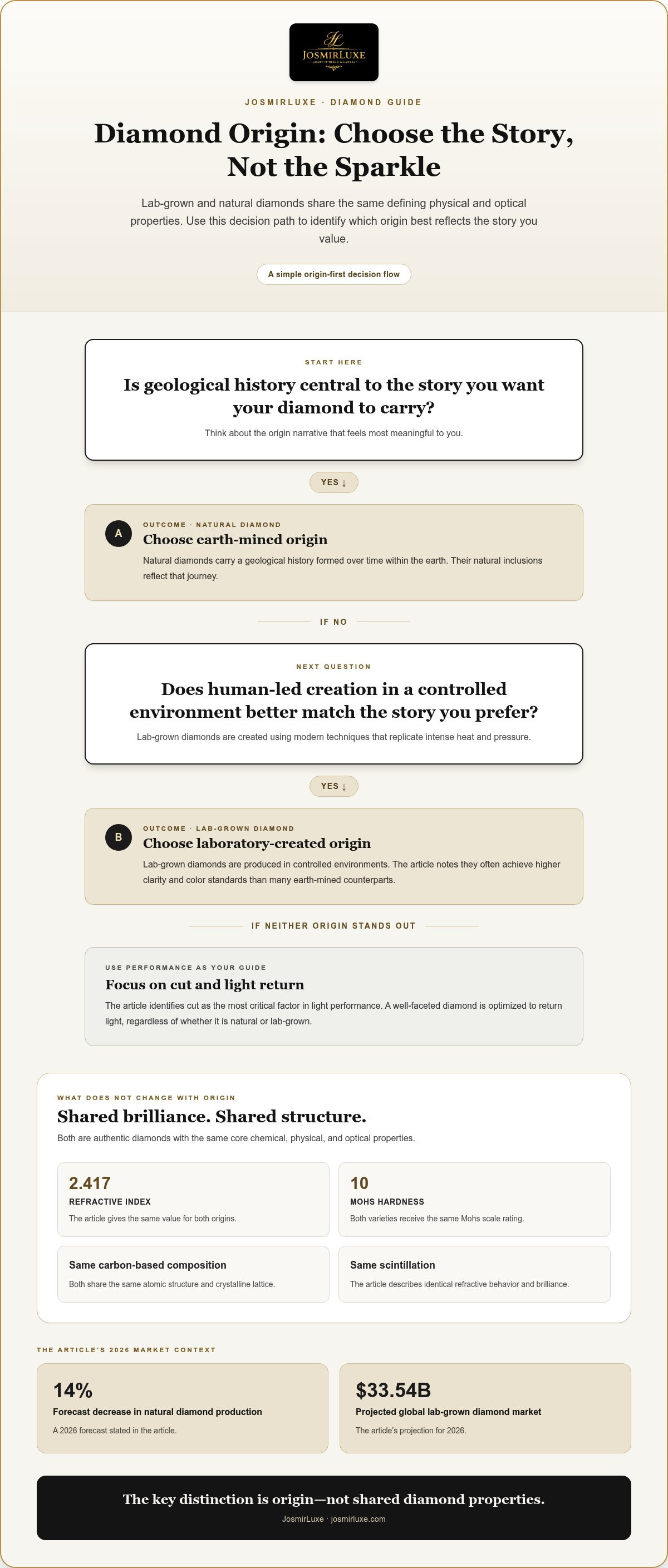
The choice between lab grown vs natural diamonds has evolved into a sophisticated dialogue about personal legacy and modern values. For generations, the allure of a diamond was rooted in its deep-earth history, a romantic narrative of geological time. However, 2026 marks a pivotal shift. As natural diamond production is forecast to decrease by 14% this year, the focus has moved toward human-led innovation. This transition represents more than a change in sourcing; it's the redefining of what makes a gemstone truly exceptional.
The Sustainable Luxury Movement
Today's JosmirLuxe clients view their jewelry as an extension of their curated lifestyle. Choosing a lab-grown stone isn't merely a practical decision. It's an emotional statement. Modern innovation now allows for a conflict-free, environmentally conscious jewelry wardrobe that doesn't compromise on the sensory experience of high-end design. This movement prioritizes the clarity of one's conscience alongside the clarity of the stone, ensuring every piece worn reflects a commitment to an elevated, intentional existence.
The Identity of the Stone
A lab-grown diamond is the physical and chemical twin of its earth-mined original, possessing the exact same atomic structure and crystalline lattice.
Both gemstones are authentic diamonds, distinguished only by their point of origin. Understanding the evolution of diamond creation reveals how modern techniques replicate the intense heat and pressure of the mantle. These stones share every defining characteristic:
- Identical refractive index and scintillation
- The same Mohs scale hardness of 10
- A matching carbon-based chemical composition
With the global lab-grown market projected to reach $33.54 billion in 2026, the industry has embraced these masterpieces as a legitimate standard of luxury. Deciding between lab grown vs natural diamonds is no longer about quality, but about the heritage you value most. Whether you are drawn to the precision of the laboratory or the ancient history of the earth found in the natural collections of Javaherati (جواهراتی), the brilliance remains unchanged.
Scintillation and Permanence: Comparing Sensory Performance
True luxury is found in the interplay of light and shadow, a dance that defines the very essence of a diamond. When comparing lab grown vs natural diamonds, the sensory experience is indistinguishable. Both gemstones possess a refractive index of 2.417, ensuring that the fire and brilliance you expect from a high-end stone remain constant regardless of its origin. This optical perfection isn't a mere imitation; it's the result of identical atomic structures reacting to light in the same breathtaking manner.
By 2026, the technological precision used to create lab-grown stones has reached a pinnacle where they often achieve higher clarity and color standards than many earth-mined counterparts. While natural stones carry unique inclusions from their volcanic journey, lab-grown diamonds are curated in controlled environments that minimize imperfections. This allows for a level of purity that was once reserved for the world's most exclusive private collections, making exceptional quality accessible to the discerning buyer.
Visual Performance in an Elevated Life
The way a diamond captures the world around it defines its character. Whether basking in the clarity of natural sunlight or the warm, ambient glow of modern pendant lighting, both stones exhibit the same deep scintillation. The quality of the cut remains the most critical factor in this performance. A masterfully faceted stone at JosmirLuxe ensures that every angle is optimized for maximum light return, creating an atmosphere of quiet elegance in any space.
Structural Integrity for Daily Elegance
A diamond's beauty must be matched by its permanence. Both varieties rank at a definitive 10.0 on the Mohs scale, making them the hardest substances known. This durability ensures that pieces like lab-grown diamond earrings can be worn daily without fear of losing their luster or sustaining surface scratches. They're resilient companions for a high-profile life. Only specialized laboratory equipment can detect the subtle markers that separate these two origins, leaving your legacy visible only through its brilliance. Explore the collection to see how these stones elevate the everyday.
Curating a Legacy: Why Lab-Grown Diamonds Define the Modern Heirloom
Choosing between lab grown vs natural diamonds is an act of personal curation. It's about deciding which narrative best resonates with your own journey and the legacy you're building. While natural stones carry the weight of geological history, lab-grown alternatives represent a forward-thinking era of ethical brilliance. Both choices are valid; however, the modern heirloom is increasingly defined by intention rather than just antiquity. At JosmirLuxe, our commitment to artisanal craftsmanship ensures that every piece meets a standard of excellence that transcends trends, regardless of the stone's origin.
A jewelry wardrobe should feel like a natural extension of your environment. The effortless versatility of lab-grown diamond earrings makes them an essential component of a quiet luxury wardrobe. They provide a subtle yet profound sparkle that transitions seamlessly from professional engagements to intimate evening gatherings. Building a cohesive aesthetic means pairing these fine jewelry investments with other curated elements of your life, such as designer sectional sofas that anchor a room with sophisticated comfort. When every detail is chosen with the same level of care, your lifestyle becomes a masterpiece of consistency.
The Lifestyle of Choice
For the modern, discerning woman, a lab-grown diamond is an intelligent choice that doesn't compromise on beauty. It offers the opportunity to prioritize visual impact and ethical transparency in one's personal style without sacrificing the sensory experience of a high-end gem. This sense of harmony extends beyond the jewelry box. Imagine the way the deep scintillation of a diamond complements the rich, hand-crafted textures of authentic Persian rugs. These pieces work in tandem to create a sanctuary of taste where quality is felt in every thread and every facet.
Discover Your Signature Piece
Your signature piece should be a reflection of who you are today and the values you wish to leave behind. We invite you to explore a collection where sustainable innovation meets timeless design, offering a new perspective on what it means to own something truly rare. The choice between lab grown vs natural diamonds is ultimately a celebration of your unique perspective. Explore the collection of masterfully crafted lab-grown diamond jewelry and find the brilliance that speaks to your story.
Embracing the New Standard of Brilliance
The dialogue surrounding lab grown vs natural diamonds has moved beyond mere technicalities to become a reflection of how we choose to live. You've discovered that these stones are identical in their physical essence, offering the same permanent luster and optical fire that defines a true heirloom. Whether you're drawn to the geological history of the earth or the refined innovation of the laboratory, the result is a masterpiece of light. True luxury in 2026 is found in this freedom of choice, where every selection is an intentional act of curation that aligns with your aesthetic values.
JosmirLuxe remains your expert guide in this evolving landscape, offering pieces that are as ethically sound as they are aesthetically profound. Our commitment to artisanal craftsmanship ensures that every setting elevates the stone it holds, creating a sense of atmosphere that improves your everyday living. By choosing sustainably sourced, conflict-free gemstones, you align your personal style with a conscious, elevated future. These expertly curated pieces are more than jewelry; they're essential components of a modern luxury lifestyle.
Explore the JosmirLuxe collection of lab-grown diamond earrings and discover how modern innovation can define your unique legacy. Let your choice be a testament to a life lived with elegance, purpose, and timeless grace.
Common Enquiries Regarding Modern Diamonds
Are lab-grown diamonds considered 'real' diamonds?
Yes, lab-grown diamonds are authentic diamonds with the exact same carbon structure as earth-mined stones. The Federal Trade Commission defines them as diamonds because they share identical chemical, physical, and optical properties. They aren't imitations like cubic zirconia; they're genuine gems created through advanced technological processes. Choosing between lab grown vs natural diamonds is simply a matter of selecting your preferred origin for a stone that's undeniably real.
Do lab-grown diamonds have any resale value compared to natural ones?
Lab-grown diamonds possess resale value, though it currently differs from natural stones. Research indicates that lab-grown gems typically resell for 10% to 30% of their original purchase price. In contrast, natural diamonds generally retain 30% to 50% of their retail value. While natural stones are often viewed as traditional financial assets, many JosmirLuxe clients prioritize the immediate lifestyle value and superior brilliance that a larger lab-grown stone provides for their daily wardrobe.
Can a jeweler tell if my diamond is lab-grown or natural?
A jeweler cannot distinguish between the two with the naked eye or a standard magnifying loupe. Because the optical properties are identical, even an experienced professional requires specialized laboratory equipment to identify the origin. Most lab-grown diamonds are laser-inscribed on the girdle with a report number or a "Laboratory Grown" designation. This ensures transparency and protects the integrity of your collection while maintaining the stone's flawless visual appeal in any light.
Will a lab-grown diamond change color or get cloudy over time?
A lab-grown diamond will never change color, fade, or become cloudy. It possesses the same permanent luster as a natural stone because it shares the same Mohs scale hardness of 10. This structural integrity ensures that your jewelry remains as brilliant decades from now as it is today. When comparing lab grown vs natural diamonds, you can trust that both offer a lifetime of clarity that won't diminish with daily wear or the passage of time.