

What if the soul of your living space isn't found in its architecture, but in the "perfect imperfections" woven into the floor beneath your feet? You likely appreciate that a home should be a sanctuary of culture and status, yet the fear of overpaying for a low-quality machine imitation often clouds the excitement of a new acquisition. Learning how to identify authentic persian rugs is the only way to move past the confusion of technical terms like weft and warp when you're seeking a piece that's more than just decor.
Mastering these details allows you to invest with absolute confidence. This guide reveals the subtle nuances of heritage craftsmanship, from the underside's natural irregularities to the tactile richness of hand-knotted wool. You'll learn why these pieces are superior investments and how JosmirLuxe curates only the finest examples of this ancient art, helping you create an atmosphere that's as authentic as it is elegant.
Key Takeaways
- Understand why the subtle irregularities of a hand-knotted piece create a living texture that industrial imitations can't replicate.
- Discover how to identify authentic persian rugs by examining the foundation's "thumbprint" and the integral nature of the fringe.
- Learn to distinguish between sterile machine-made perfection and the soulful artistry tied into every individual knot of a genuine masterpiece.
- Gain the confidence to select a JosmirLuxe legacy asset that transforms your home into a refined gallery of culture and status.
Distinguishing the Human Touch from Industrial Production
Hand-knotted Persian rugs aren't just floor coverings; they're unique works of art. Every single knot is tied individually by a master weaver, a process that can take months or even years. While industrial machines churn out "perfect" replicas in a matter of hours, these pieces often feel sterile and flat. In contrast, human hands create a living texture that catches and evolves with the light in your room. Understanding this organic character is the first step in learning how to identify authentic persian rugs. Hand-knotted craftsmanship remains the gold standard of textile art that increases in value over generations. For a comprehensive overview of Persian carpets and their historical significance, one must look toward the structural integrity of the weave itself.
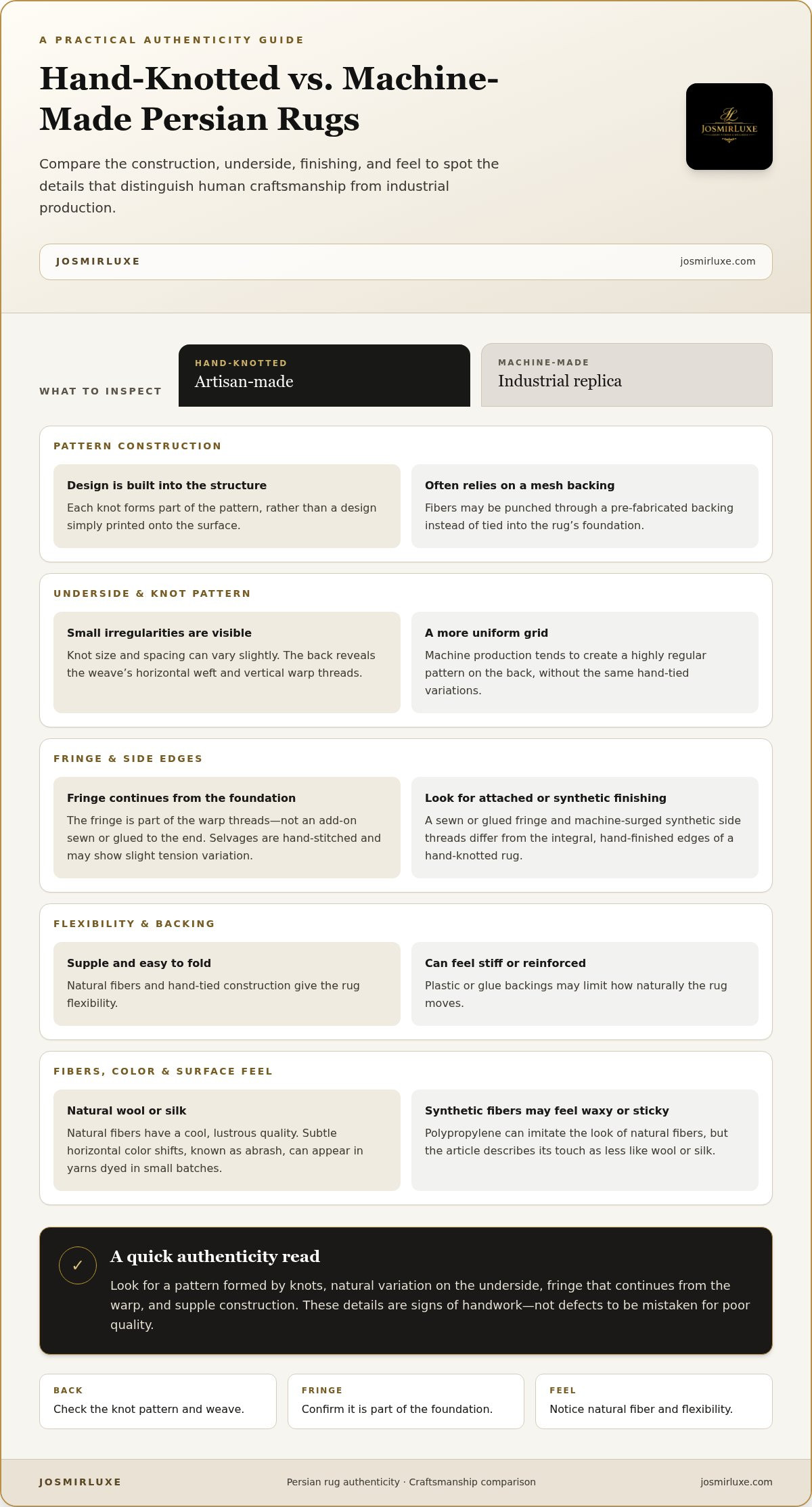
A primary distinction lies in how the pattern exists within the rug. In an authentic masterpiece, the design is an inseparable part of the structure. It isn't merely printed on the surface; it's built knot by knot, ensuring the artistry remains vibrant even after decades of use.
The Anatomy of the Weave: Hand-Knotted vs. Machine-Made
Machine-made rugs typically rely on a pre-fabricated mesh backing. Fibers are simply punched through this synthetic layer, which lacks the structural resilience of a hand-tied knot. When you look at an authentic rug, you're seeing the weft and warp, which is the horizontal and vertical threads that form its skeleton. These elements work together as a cohesive unit in genuine pieces.
This structural difference affects how the rug behaves in your space. Industrial replicas are often stiff, reinforced by plastic or glue backings that prevent them from moving naturally. A genuine hand-knotted rug from JosmirLuxe is remarkably flexible. You can easily fold it, a testament to the supple nature of natural fibers and the expertise of the artisan's touch.
The Narrative Written on the Underside: Key Physical Markers
Turning a rug over reveals its true identity. The back acts as a "thumbprint" of the artisan who created it. You'll see slight irregularities in knot size and spacing, which prove its human origin. Machines produce a grid that's too perfect, lacking the soul of a hand-tied piece. Understanding these visual cues is essential when learning how to identify authentic persian rugs.
Pay close attention to the fringe and edges. In a genuine masterpiece, the fringe is an extension of the rug's foundation threads, known as the warp. It shouldn't ever be sewn or glued onto the end. Similarly, the side edges, or selvages, are hand-stitched. You'll notice a slight variance in tension that machine-surged synthetic threads simply can't replicate. Look also for "abrash," those subtle, horizontal shifts in color that indicate the use of small-batch, vegetable-dyed yarns.
Material Integrity: The Feel of Natural Fibers
Natural silk and high-grade wool possess a cool, lustrous quality that synthetic polypropylene mimics poorly. While machine fibers often feel waxy or even "sticky" to the touch, the natural materials curated by JosmirLuxe actually improve with age. They develop a soft, glowing patina over decades that machine-made replicas can never achieve. Natural dyes also interact with sunlight to create a profound depth of color, transforming the atmosphere of your space into a gallery of light and shadow. If you're ready to see these heritage details in person, we invite you to explore the collection.
The Legacy of Heritage: Persian Rugs as Living Art
An authentic Persian rug serves as a bridge between historical artistry and modern luxury. It's an essential component of an elevated lifestyle. While a machine-made rug is merely a disposable commodity, a hand-knotted piece from JosmirLuxe is a legacy asset. It anchors a room with a sense of history, comfort, and sophisticated design. Choosing such a piece is an exercise in discernment. It's much like selecting lab grown diamond earrings; it represents a conscious choice for quality and timelessness.
Understanding how to identify authentic persian rugs is about more than avoiding imitations. It's about recognizing the soul of a space. A genuine rug doesn't just sit on the floor. It transforms the atmosphere, absorbing sound and adding a layer of physical warmth that synthetic fibers cannot match. This emotional resonance is what distinguishes a curated home from a decorated house.
Curating Your Space with JosmirLuxe
Selecting a rug is a profound form of self-expression. It's an invitation to bring global heritage into your daily life. To create a truly cohesive, aspirational atmosphere, consider how these intricate patterns pair with other luxury elements. A vintage Tabriz rug provides the perfect textural counterpoint to the clean lines of designer sectional sofas.
Trusting in professional curation ensures that every element of your home is a verified masterpiece. At JosmirLuxe, we handle the rigorous vetting process for you. This allows you to focus on the aesthetic harmony of your environment. Every piece we offer is a testament to the intersection of traditional heritage and contemporary elegance. Explore the collection to find the anchor for your next interior evolution.
Embrace the Art of Heritage Craftsmanship
Owning a hand-knotted masterpiece is about more than just decor; it's about anchoring your home with a piece of cultural history. By understanding how to identify authentic persian rugs, you transition from a casual observer to a discerning collector. You now recognize that the slight irregularities on the underside and the integral nature of the fringe aren't flaws. Instead, they're the unique signature of an artisan's soul. These investment-grade pieces offer a tactile richness that machine-made imitations can't replicate, evolving gracefully with your lifestyle over generations.
At JosmirLuxe, we specialize in a curated selection of verified hand-knotted masterpieces that seamlessly integrate with modern luxury interiors. We invite you to explore the collection of authentic hand-knotted Persian rugs at JosmirLuxe and discover the perfect anchor for your sanctuary. Your journey into the world of heritage craftsmanship begins with a single, conscious choice for quality.
Frequently Asked Questions
How can I tell if a rug is hand-knotted or machine-made at a glance?
Look at the back of the piece to see if the pattern is as clear as it is on the front. In hand-knotted rugs, each individual knot is visible and slightly irregular. Machine-made versions usually have a uniform mesh or a stiff backing that feels like plastic. Checking for these structural details is the fastest way to learn how to identify authentic persian rugs at a glance.
Is a higher knot count always a sign of a better Persian rug?
Knot density is an indicator of detail, but it isn't the sole measure of value. The quality of the hand-spun wool and the complexity of the vegetable dyes often matter more than knots per square inch. A tribal rug with a lower count might possess more artistic soul and investment potential than a high-density industrial copy. Authentic quality is found in the harmony of all elements.
Why is the fringe so important when identifying an authentic rug?
The fringe is a structural extension of the rug's foundation threads. In a genuine piece, these threads run through the entire body of the carpet. You should never see a seam where the fringe meets the rug. If it appears sewn or glued on, it's an industrial imitation. This structural integrity ensures your JosmirLuxe acquisition remains a durable legacy for your home.
Do authentic Persian rugs always have imperfections in their pattern?
Subtle irregularities are the signature of a master weaver. These "perfect imperfections" prove that a human hand, not a sterile machine, created the piece. You might notice slight variations in the pattern or color shifts called abrash. Embracing these unique traits is essential when you're discovering how to identify authentic persian rugs that anchor a room with genuine cultural history and status.
What is the difference between a Persian rug and an Oriental rug?
"Oriental rug" is a general term for hand-knotted carpets made across Asia, including India and China. "Persian rug" specifically denotes a piece crafted in Iran using traditional heritage techniques. These rugs are the gold standard of the industry due to their historical significance and superior materials. JosmirLuxe curates only these authentic Persian masterpieces to ensure your space reflects the highest level of sophistication.