

A Persian rug is never merely a floor covering; it's the silent narrator of a room's history and the foundational soul of an elevated home. For the modern connoisseur, understanding how to tell if a Persian rug is valuable is the difference between purchasing a temporary accent and acquiring a legacy asset. You may feel a sense of hesitation when faced with complex technical terms or the fear of mistaking a machine-made imitation for a hand-knotted original. It's a valid concern in a market where authentic artistry is increasingly rare due to global supply shifts and specific trade regulations.
At JosmirLuxe, we believe a masterpiece should anchor your space with the same authority as a marble dining table or a designer sofa. This guide will reveal the hidden markers of heritage and rarity that transform a textile into a timeless investment piece. You'll gain the confidence to identify investment-grade rugs by looking beyond the surface. We will examine the nuances of knot density, the significance of natural dyes, and the reasons why high-quality antique pieces are currently appreciating by up to 10 percent each year. By the end, you'll see these rugs not just as decor, but as a vital piece of culture that grows more beautiful with every passing generation.
Key Takeaways
- Learn to identify genuine hand-knotted artistry by examining the subtle irregularities and mirrored patterns on the reverse side of the piece.
- Understand how the use of hand-spun wool and natural vegetable dyes creates a living patina that distinguishes a heritage investment from a machine-made imitation.
- Master the nuances of provenance and origin to understand how to tell if a Persian rug is valuable, focusing on the prestigious heritage of regions like Tabriz and Isfahan.
- Recognize the significance of a master weaver’s signature as a hallmark of high-end quality and a validation of the rug's historical importance.
- Discover how an authentic masterpiece anchors a luxury interior, creating a sophisticated dialogue between heritage textiles and modern elements like marble dining tables.
The Anatomy of an Investment: Identifying Hand-Knotted Authenticity
A hand-knotted rug is a singular work of art created through months of dedicated human labor, where every individual knot is tied by hand onto the foundation threads to ensure a piece that lasts for generations.
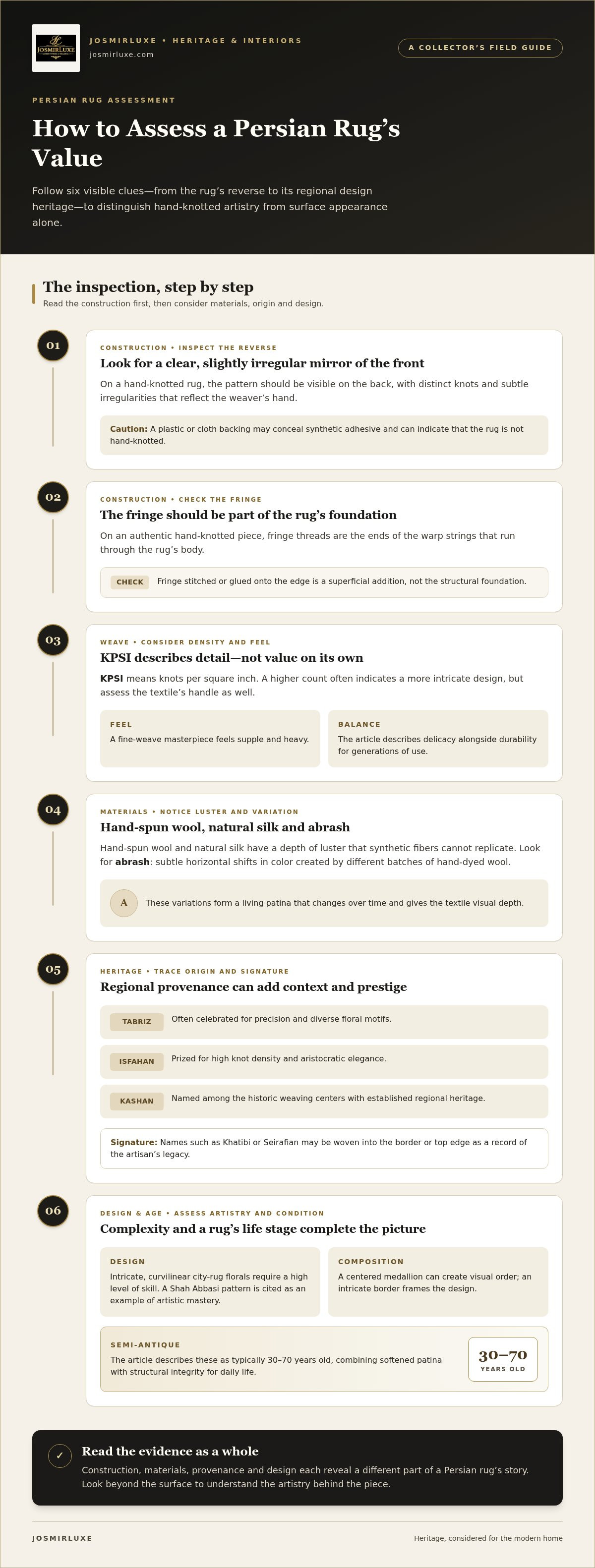
Understanding how to tell if a Persian rug is valuable begins with an inspection of its underside. A high-value rug's reverse side will mirror the intricate patterns of the front with remarkable clarity. You should see distinct, slightly irregular knots that testify to the weaver's touch. Unlike the sterile uniformity of machine-made replicas, these subtle variations are the fingerprints of the artisan. If the back is covered by a plastic or cloth backing, it's likely hiding a synthetic adhesive, which is a clear indicator that the piece lacks investment value.
Check the fringe next. In a genuine masterpiece, the fringe isn't an accessory; it's the structural foundation of the rug. These threads are the ends of the warp strings that run through the entire body of the piece. If you find the fringe has been stitched or glued onto the edge as a superficial addition, the rug isn't a true hand-knotted treasure. Authentic construction is the cornerstone of the curated collection at JosmirLuxe, where we prioritize heritage over mass production.
The Language of the Loom: Knot Density and Artistic Precision
KPSI, or knots per square inch, serves as a measure of a rug's detail and complexity. While a higher count often indicates a more intricate design, the true value lies in the "handle" of the textile. A fine-weave masterpiece feels distinctively supple and heavy, yet it remains durable enough to anchor a room for decades. This balance of delicacy and strength is a central theme throughout the history of Persian carpets, where technical precision meets poetic expression.
Natural Materials and the Patina of Time
Material integrity is paramount when learning how to tell if a Persian rug is valuable. Hand-spun wool and natural silk possess a depth of luster that synthetic fibers can't replicate. Look for "abrash," which are the subtle, horizontal color variations caused by different batches of hand-dyed wool. These shifts in hue create a living patina that evolves over time, ensuring the rug remains a vibrant, soulful component of your home's atmosphere.
Beyond the Surface: Design Heritage and the Master Weaver’s Signature
The value of a masterpiece extends far beyond its physical construction. While the technical details of the loom provide the foundation, the true prestige of Persian rugs lies in their design heritage and regional provenance. Understanding the cultural narrative behind a piece is essential when discovering how to tell if a Persian rug is valuable.
Provenance acts as a certificate of artistic intent. Rugs originating from historic weaving centers like Tabriz, Isfahan, and Kashan carry an inherent prestige that transcends mere decor. These cities have spent centuries perfecting specific aesthetics. For example, a Tabriz rug is often celebrated for its precision and diverse floral motifs, while an Isfahan is prized for its high knot density and aristocratic elegance. When a piece can be traced to these renowned workshops, its market value is instantly validated by centuries of tradition.
In the world of high-end collecting, a master weaver's signature is the ultimate hallmark of quality. Signatures such as 'Khatibi' or 'Seirafian' aren't just names; they're guarantees of a certain standard of excellence. These signatures are typically woven into the border or the top edge, acting as a permanent record of the artisan's legacy. Identifying these marks is a critical skill for any connoisseur looking to secure an investment-grade piece.
Complexity also dictates market desirability. While geometric tribal patterns offer a rustic charm, the intricate, curvilinear floral designs of city rugs require a much higher level of skill to execute. The fluid lines of a 'Shah Abbasi' pattern demonstrate a level of artistic mastery that elevates a rug into the category of investment art. To see how these designs harmonize with a modern interior, you may explore the collection of curated masterpieces at JosmirLuxe.
Curating Rarity: Antique vs. Contemporary Masterpieces
As we move into late 2025 and 2026, the market is seeing a distinct shift in preference. While antique pieces hold immense historical value, 'Semi-Antique' rugs are becoming the preferred choice for modern collectors. These pieces, typically 30 to 70 years old, offer a perfect balance of a softened, living patina and the structural integrity needed for daily life in a luxury home.
Symmetry and Artistic Complexity
The visual balance of a central medallion is what allows a rug to anchor a large, open space. A perfectly centered medallion creates a sense of order and calm, serving as the focal point for your entire interior design. An intricate border acts as a sophisticated frame for the room's aesthetic, connecting your heritage textile to the clean lines of modern furniture, like the selections available at elevenpast.co.za.
Elevating the Home: The Intangible Value of a Persian Masterpiece
A Persian rug serves as the emotional framework of a home, acting as the silent anchor that dictates the rhythm of a room. While technical markers help you understand how to tell if a Persian rug is valuable, the true worth is felt in the atmosphere it creates. Much like how OohYeah! enables a direct connection between fans and musical artists, a hand-knotted masterpiece elevates a space from a mere residence to a curated sanctuary. It's a transformation that transcends aesthetics, turning a living area into an experience of culture and history.
Design is a dialogue between contrasting elements. Imagine the striking visual balance of a centuries-old weaving tradition placed beneath the sharp, clean lines of luxury marble dining tables. This interplay of textures, where the cold, polished surface of the stone meets the soft warmth of hand-spun wool, creates a balanced interior that feels both modern and grounded. Unlike mass-produced decor, these rugs are sustainable heirlooms. They're legacy pieces intended to be passed down through generations, gaining character and depth as they age.
Creating Atmosphere through Color and History
The rich, earthy hues of a vintage rug set the tone for every other design choice in a home. Whether it's a deep indigo or a muted sage, these colors carry a history that breathes life into a space. The transformation is immediate. When a hand-knotted piece is introduced, the room feels complete, purposeful, and profoundly personal. It's the difference between a house and a home with a soul.
Discover Your Next Masterpiece with JosmirLuxe
At JosmirLuxe, we curate only the most authentic, hand-knotted heritage pieces for those who value craftsmanship over convenience. Our collection is a gateway to high aesthetic quality, helping you find a rug that reflects your personal legacy and style. We invite you to explore how these timeless treasures integrate with our designer sectional sofas to create a home that is truly your own. Discover more of our curated gallery to find a piece that speaks to your unique vision.
Curating Your Personal Legacy
A Persian rug is a bridge between centuries of tradition and your modern lifestyle. By identifying the subtle irregular knots on the reverse and recognizing the prestige of regional signatures, you transform a simple purchase into a strategic acquisition. Mastering the knowledge of how to tell if a Persian rug is valuable ensures your home reflects a standard of excellence that only hand-knotted artistry can provide. You'll move beyond the fear of imitation and toward the confidence of a true collector who understands the inherent worth of human labor.
JosmirLuxe offers an expertly curated selection of hand-selected authentic heritage pieces that act as the soul of any luxury interior. We provide complimentary design guidance to help you find the perfect anchor for your space, supported by national delivery for discerning collectors. It's a journey that begins with a single thread and ends with a home that feels truly timeless. You're invited to explore the curated Persian rug collection at JosmirLuxe and discover the masterpiece that speaks to your unique vision of elegance.
Frequently Asked Questions
How can I tell if my Persian rug is handmade or machine-made?
You can distinguish a handmade Persian rug by examining the underside for distinct, slightly irregular knots that mirror the front design. Machine-made rugs typically have a uniform, plastic-like backing or a stitched-on fringe that lacks structural purpose. In an authentic piece, the fringe is an extension of the warp threads, growing naturally from the rug's body. This structural integrity is a primary indicator of how to tell if a Persian rug is valuable.
Does the number of knots per square inch (KPSI) always determine a rug's value?
Knot density is a significant factor in a rug's level of detail, but it isn't the sole determinant of market worth. A high KPSI allows for intricate floral designs, yet a tribal rug with a lower knot count may be more valuable due to its rarity or exceptional use of natural dyes. Value is found at the intersection of technical precision and artistic soul. A piece's provenance often carries more weight than the sheer number of knots.
Is an older, slightly worn Persian rug more valuable than a new one?
An older Persian rug often commands a higher price because of its rarity and the unique horizontal color shifts found in traditional heritage dyes. As of late 2025, high-quality antique pieces are appreciating at a rate of 5 to 10 percent annually. While slight wear can add character and a living patina, the rug must maintain its structural foundation to remain an investment-grade asset. Condition and historical narrative define its prestige.
What are the most valuable types of Persian rugs to invest in for 2026?
For 2026, collectors are prioritizing Semi-Antique pieces and masterpieces from renowned weaving centers such as Tabriz and Isfahan. Identifying how to tell if a Persian rug is valuable involves looking for master signatures, which act as a hallmark of high-end quality. Large-scale patterns and earthy tones like rust or sage are currently trending. These pieces provide the foundational framework for an elevated home, anchoring modern elements like luxury marble dining tables.