

What if the most significant investment in your home isn't the art hanging on your walls, but the hand-woven masterpiece resting beneath your feet? Many collectors understand that a genuine Persian rug brings an irreplaceable sense of history and status to a room, yet the fear of overpaying for a clever imitation often creates hesitation. Learning how to determine Persian rug value Dallas homeowners can rely on is the essential first step toward curating a space that feels both grounded and exceptionally refined.
At JosmirLuxe, we view these textiles as living legacies rather than mere decor. This guide will help you navigate the complexities of knot density and regional styles with the eye of a seasoned connoisseur. You'll discover how to identify authentic craftsmanship and understand why certain pieces appreciate over generations. We're going to transform your perspective on high-end textiles, ensuring your next acquisition is a source of pride and a cornerstone of your home's unique atmosphere. Explore the nuances of heritage weaving and find the piece that speaks to your lifestyle.
Key Takeaways
- Identify the historical significance of legendary weaving centers and how provenance influences a rug’s rarity.
- Confidently apply professional techniques for how to determine Persian rug value Dallas experts recommend to ensure your investment is authentic.
- Look beyond knot density to evaluate the material quality and artistic soul that define a truly exceptional piece.
- Learn to inspect heritage rugs with a curator’s precision, focusing on condition and structural integrity.
- Understand how a hand-knotted rug serves as a sophisticated anchor, bridging the gap between modern design and timeless culture.
The Essence of Provenance: How Origin and Artistry Dictate Value
A Persian rug is a silent narrator of history. Its worth isn't just a number; it's a reflection of the months or years spent at the loom. When considering how to determine Persian rug value Dallas collectors often look first at the story behind the weave. This is where provenance meets artistry. True value emerges from a combination of historical heritage, material purity, and the specific intent of the weaver.
The Role of Regional Heritage
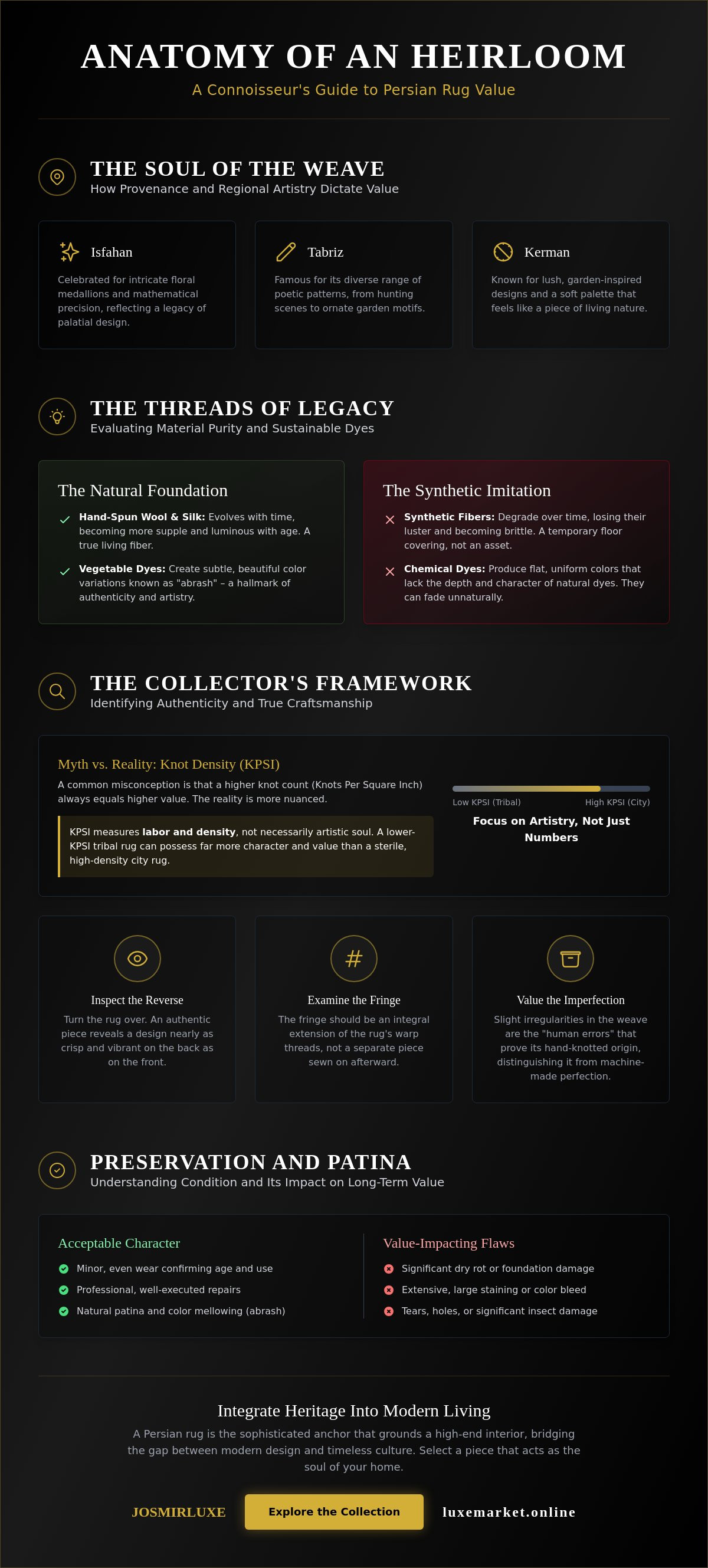
Every city has a unique voice. Isfahan is celebrated for its intricate floral medallions and mathematical precision. Tabriz is famous for its diverse, often poetic patterns. Kerman rugs frequently feature lush, garden-inspired designs that feel like a piece of living nature. These aren't just styles; they're signatures. Understanding the history and cultural significance of Persian carpets allows you to see the weaver's intent. Certain antique motifs, once common in tribal villages, are no longer produced. These disappearing patterns make specific pieces rare treasures in the modern market.
Material Integrity and Sustainability
Quality begins with the fiber. JosmirLuxe prioritize pieces made from hand-spun wool and organic silk. These natural materials don't just last; they evolve. Synthetic fibers eventually degrade and lose their luster, but high-quality wool becomes more supple and luminous with age. Vegetable dyes contribute significantly to this transformation. They create a beautiful, intentional variation in color known as "abrash." This natural patina is a hallmark of authenticity that increases value over time. It's a sustainable choice that anchors a room with an atmosphere of quiet luxury and ethical craftsmanship.
True value is measured by the time invested in the loom. A single rug can represent thousands of hours of focused, manual labor. This dedication is what transforms a floor covering into a piece of fine art. When you understand how to determine Persian rug value Dallas homes become galleries of heritage rather than just decorated spaces. It's about selecting a piece that will appreciate as both a financial asset and a cultural heirloom.
The Collector’s Framework: Evaluating Craftsmanship and Condition
Evaluating a textile masterpiece requires a shift from passive admiration to active observation. While the history of a piece provides its context, its physical state reveals its true market position. When learning how to determine Persian rug value Dallas enthusiasts often start by looking past the surface to the structural integrity of the weave. True value isn't just about the absence of wear; it's about the presence of character.
A common misconception is that a higher knot count always equals higher quality. While Knots Per Square Inch (KPSI) is a metric of labor rather than just quality, it shouldn't be the sole factor in your decision. A tribal rug with a lower KPSI can possess more soul and artistic merit than a high-density city rug that lacks character. Authentic hand-knotted art breathes through its slight irregularities. These human "errors" are actually proof of origin, distinguishing the piece from the sterile perfection of a machine.
Identifying Hand-Knotted Authenticity
To truly understand a piece, you must look at its foundation. Turn the rug over; the design should be almost as vibrant on the back as it is on the front. On a genuine piece, the fringe isn't sewn on as an afterthought but is an extension of the rug's warp threads. You can identify an authentic hand-knotted rug by these structural signatures that no machine can replicate. If you're looking to elevate your space, you can explore the collection of curated pieces at JosmirLuxe.
Assessing Condition and Rarity
Condition is a delicate balance of preservation and history. Minor wear or professional repairs don't necessarily devalue a heritage piece. They often confirm its age and use in a lived-in environment. However, significant dry rot or extensive staining can impact the long-term appreciation of the investment. Symmetry and size also play roles in desirability. While tribal rugs celebrate organic shapes, larger city rugs are prized for their architectural balance and ability to anchor an expansive room.
The JosmirLuxe Ethos: Integrating Heritage into Modern Living
A Persian rug is more than a decorative choice; it's the anchor that grounds a high-end interior. While earlier sections explored the technicalities of weave and origin, the ultimate value of a piece is found in how it transforms your daily environment. Mastering how to determine Persian rug value Dallas collectors can rely on allows you to select a piece that acts as the soul of your home. At JosmirLuxe, we believe a hand-knotted masterpiece bridges the gap between contemporary design and ancient culture, turning a house into a curated experience.
Curating for Atmosphere and Comfort
The modern aesthetic often leans toward clean lines and cool materials. A heritage rug provides the essential warmth and texture needed to balance these elements. Imagine the striking contrast of a deep-toned Tabriz beneath one of our luxury marble dining tables, or the plush comfort of an antique tribal weave paired with a designer sectional sofa. This juxtaposition creates a sophisticated dialogue between the past and the present. By visiting the JosmirLuxe Homepage, you can begin to visualize how these textures elevate the physical and emotional atmosphere of your living space.
The Future of Heritage Collecting
Choosing an authentic rug is an act of conscious curation. In an era of disposable, fast-fashion decor, a hand-knotted Persian rug stands as a sustainable legacy piece. It's an investment that outlasts fleeting trends, gaining character and value as it passes through generations. Understanding how to determine Persian rug value Dallas homeowners can trust ensures that your selection is not just a purchase, but a cornerstone of a refined lifestyle.
Investing in art you can walk on is a powerful statement of personal style. It reflects a commitment to quality over quantity and a deep appreciation for the human element in design. We invite you to explore the collection for pieces that resonate with your personal aesthetic and help you craft a home that feels like a true reflection of your journey.
Elevating Your Home with Timeless Artistry
Selecting a hand-knotted rug is a journey into cultural history that requires both an educated eye and an emotional connection. You've learned that true value lies in the marriage of historical provenance and the material integrity of hand-spun wool and organic silk. By mastering how to determine Persian rug value Dallas homeowners can transform their living spaces into galleries of heritage that reflect a sophisticated, modern lifestyle. These pieces aren't just floor coverings; they're sustainable legacies that bridge the gap between contemporary design and ancient craftsmanship.
At JosmirLuxe, we curate a selection of authentic hand-knotted art for the collector who values timeless design over fleeting trends. Our focus on sustainable luxury ensures that every piece in our collection serves as a foundational element for a refined atmosphere. We invite you to explore the JosmirLuxe collection of hand-knotted heritage rugs and find the masterpiece that resonates with your personal aesthetic. Let your home tell a story of quality and culture that will be cherished for generations to come.
Frequently Asked Questions
How can I tell if a Persian rug is truly hand-knotted?
You can identify an authentic hand-knotted piece by examining the underside and the fringe construction. On a genuine rug, the intricate design is visible on the back with slight, organic variations in the knots. The fringe is a continuation of the rug's foundation threads rather than an attached strip. These details are essential when learning how to determine Persian rug value Dallas collectors look for in heritage pieces.
Does a higher knot count always mean a rug is more valuable?
Knot density is a measure of time and labor, but it isn't the sole indicator of worth. While fine city rugs like Isfahan boast high counts, tribal pieces often have lower density yet command high prices due to their rarity and artistic soul. A piece's value is a balance of craftsmanship, material purity, and historical significance. It's about how the rug resonates as a component of an elevated lifestyle.
What is the difference between an antique and a vintage Persian rug?
The primary distinction lies in the age and historical era of the weaving. An antique Persian rug is traditionally defined as being at least 100 years old, representing a specific period of artisanal heritage. Vintage rugs are typically between 30 and 99 years old. Both categories offer investment potential, but antiques often possess a higher level of rarity and a more pronounced patina that reflects their long-term journey through time.
How do natural dyes affect the long-term value of a rug?
Natural vegetable dyes significantly enhance a rug’s long-term appreciation because of how they age. Unlike synthetic alternatives, organic dyes develop a soft, luminous patina known as abrash, which adds depth and character to the design. This natural evolution is highly sought after by connoisseurs. When researching how to determine Persian rug value Dallas experts emphasize that these sustainable materials ensure the piece remains a timeless anchor in any luxury interior.