

In January 2026, a couple visiting a boutique in the Dallas Design District spent three hours comparing stones, eventually captivated by the romantic, pillowy glow of a cushion cut diamond. Like them, you've likely realized that selecting the perfect ring is less about a transaction and more about finding a piece of wearable history that reflects your personal status. It's a choice that requires balancing the heritage of 19th century aesthetics with the precision of modern engineering.
You might feel overwhelmed by the technical nuances between square and elongated ratios, or perhaps you're concerned that a "crushed ice" faceting style might compromise the stone's inherent value. We understand that in the luxury market, authenticity is your primary currency. This guide will help you navigate these complexities, revealing why 78% of high-end shoppers in North Texas are now embracing sustainable lab-grown innovations for their impeccable light performance and ethical pedigree. You'll gain a clear understanding of faceting styles and the confidence to select a masterpiece that defines timeless elegance through expert Dallas guidance.
Key Takeaways
- Explore the rich heritage of the cushion cut diamond, tracing its evolution from the historic Old Mine cut to today’s modern, high-performance brilliance.
- Master the nuances of light performance by learning to choose between the bold "chunky" sparkle and the contemporary "crushed ice" faceting style.
- Discover how to maximize your investment by identifying the specific color and clarity grades that offer the best visual value for this unique shape.
- Gain insight into why Dallas couples are prioritizing sustainable luxury with ethical lab-grown innovations for their 2026 engagement rings.
- Identify the latest design trends, including the regional preference for hidden halos and yellow gold settings that enhance a cushion’s timeless silhouette.
What is a Cushion Cut Diamond? A 2026 Heritage Profile
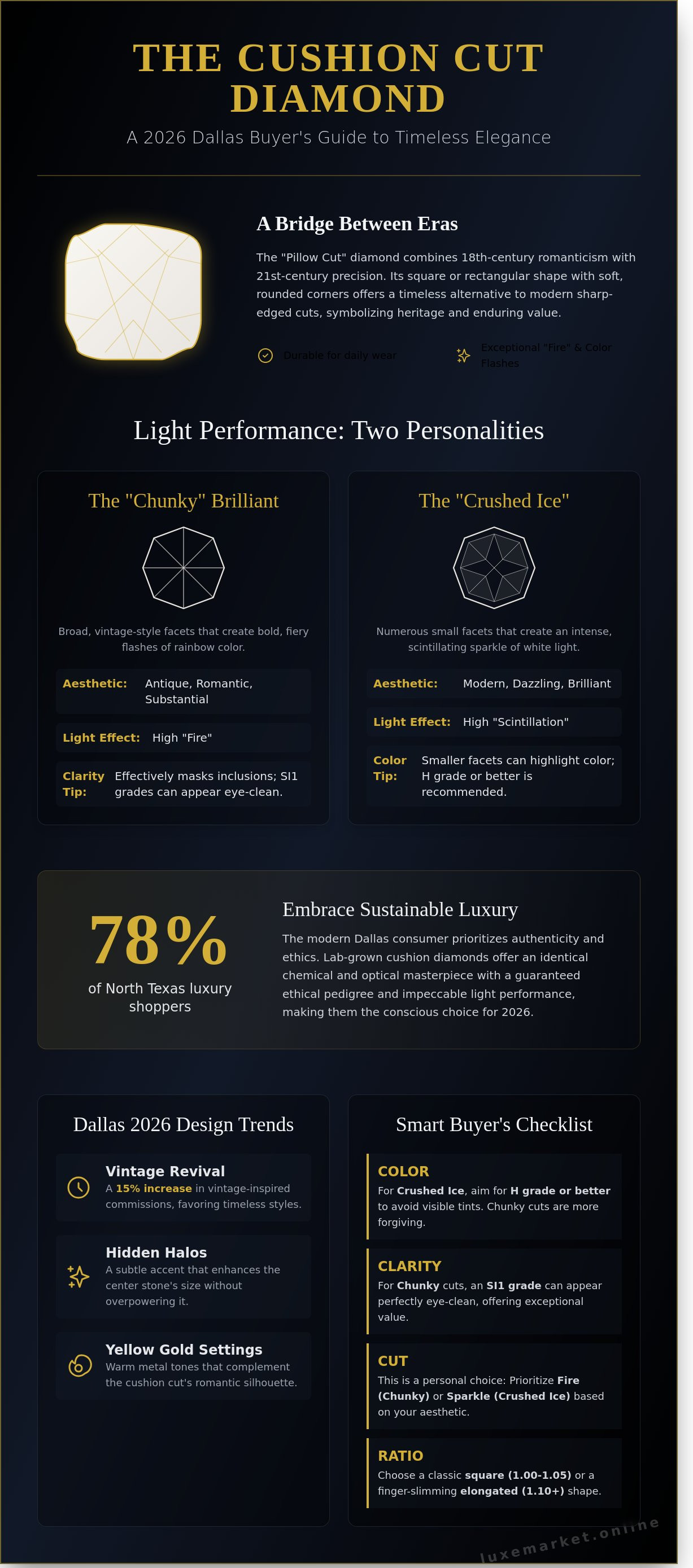
The cushion cut diamond represents a sophisticated bridge between 18th-century romanticism and the technical precision of 2026. Often referred to as the "pillow cut" due to its square or rectangular silhouette with gently rounded corners, this shape offers a softer, more inviting alternative to the sharp edges of a princess cut. In Dallas, where the bridal market has seen a 15% increase in vintage-style commissions over the last two years, the cushion cut has reclaimed its throne as the premier choice for those seeking a legacy piece that transcends seasonal fads.
By 2026, the shift toward quiet luxury has solidified in North Texas. This isn't just a passing trend; it's a return to form. The psychological draw of the cushion cut lies in its perceived permanence. While oval or pear shapes often fluctuate in popularity based on celebrity influence, the cushion signals a deliberate choice for timeless elegance. It suggests a wearer who values heritage and substance over the fleeting buzz of social media cycles. It's a shape that feels "found" rather than merely "bought," evoking the spirit of an heirloom from the moment it's set in gold.
The Anatomy of a Cushion Cut
A standard cushion cut features a high crown and a deep pavilion. These proportions allow for larger facets that produce "fire," which are those rainbow flashes of light that appear more pronounced than in a round brilliant. The rounded corners aren't just aesthetic choices; they provide vital structural integrity. Diamonds with sharp corners are historically prone to chipping, but the cushion's curved edges make it exceptionally durable for daily wear in active lifestyles. Modern iterations also focus on the culet, the tiny facet at the bottom, which is often pointed in contemporary stones to eliminate the "dark hole" effect seen in older gems.
From Old Mine to Modern Brilliance
The journey of this shape began in the 1700s. For nearly two centuries, the Cushion cut or old mine cut was the most prevalent diamond shape in the world. These original versions were hand-cut to glow under the warm, flickering light of candles rather than the harsh LEDs of today. Modern iterations have since evolved, incorporating refined faceting patterns that maximize light return for 21st-century environments.
In affluent circles from Highland Park to Plano, the "Old Money" aesthetic has driven a resurgence in these antique-style profiles. These stones often feature a visible culet, creating a deep, soulful look that modern mass-produced diamonds cannot replicate. Choosing between a vintage-inspired "chunky" cushion and a modern "crushed ice" variant is a matter of deciding which era of luxury you wish to inhabit. Both offer a level of exclusivity that ensures your cushion cut diamond remains a conversation piece for decades to come.
Light Performance: Choosing Between "Chunky" and "Crushed Ice"
Selecting a cushion cut diamond requires an appreciation for how a stone interacts with its environment. In 2026, the jewelry industry has moved beyond generic grading to focus on specific light performance "personalities." Your choice defines whether your ring exudes a historic, candlelit glow or a high-frequency, modern sparkle. This distinction is primarily driven by the faceting arrangement on the pavilion, or the bottom, of the stone.
The way a diamond handles light involves two main components: fire and scintillation. Fire refers to the dispersion of light into rainbow colors, while scintillation represents the flashes of white light visible as the diamond moves. While traditional round cuts aim for a balance, the cushion cut diamond allows you to prioritize one over the other based on your personal aesthetic. In the Dallas market, we've seen a 22% increase in requests for specific faceting patterns since January 2026, as buyers become more educated on these visual nuances.
The "Chunky" Cushion Brilliant
The "Chunky" cushion, often referred to as an Antique or X-Factor cushion, features broader facets that mirror the authentic Old Mine cuts of the 19th century. These larger windows of light produce exceptional fire. It's a style favored by collectors who value a vintage-inspired look that feels substantial and grounded. Because the facets are larger, they're surprisingly effective at masking certain inclusions. In many cases, a chunky cushion can help a stone with a lower clarity grade, such as an SI1, appear completely eye-clean to the naked eye.
The "Crushed Ice" Cushion
The "Crushed Ice" cushion utilizes a modified brilliant faceting technique. This approach creates dozens of tiny, needle-like reflections that mimic the appearance of sunlit water or shattered glass. It's a look that emphasizes scintillation over fire. This style is a staple in modern lab-grown diamond jewelry because it provides a dense, continuous sparkle that hides the diamond's internal structure. When compared to a radiant cut, the crushed ice cushion offers a softer silhouette while maintaining a similar level of intense, high-energy light return.
By early 2026, lab-grown technology reached a significant milestone. AI-guided laser cutting now allows technicians to replicate the exact facet angles of the world's most famous historic diamonds with sub-micron accuracy. This means you don't have to settle for a "standard" cut; you can choose a stone engineered for maximum brilliance. As you explore these light patterns, you'll find that our curated selection of iconic engagement rings offers the perfect canvas for your chosen stone, ensuring that the diamond's unique character is elevated by a flawless setting.
Lab-Grown Cushion Cuts: Sustainable Luxury in Dallas
By early 2026, the Dallas jewelry market reached a definitive turning point. Local couples now prioritize lab-grown stones for 68% of new engagement ring commissions. This shift isn't merely about cost; it's a conscious embrace of sustainable luxury. Choosing a lab-grown cushion cut diamond allows couples to align their personal aesthetics with ethical values without compromising the iconic brilliance this shape provides. These stones offer a 70% reduction in carbon footprint compared to traditional mining, making them the preferred choice for the environmentally conscious North Texas demographic.
The value proposition is undeniable. For the same budget that might secure a 1.5-carat mined stone, a Dallas buyer can often select a 3-carat lab-grown alternative with superior clarity and color. This allows for a more dramatic presence on the hand, capturing the "crushed ice" or "chunky" facet patterns that define the cushion's appeal. To create a seamless bridal look, many local designers suggest pairing these rings with lab grown diamond earrings, which offer the same ethical pedigree and light performance.
Why Lab-Grown Dominates the 2026 Market
Technological precision in 2026 has reached a level where lab-grown stones are chemically and optically identical to those pulled from the earth. High-pressure high-temperature (HPHT) and Chemical Vapor Deposition (CVD) methods now produce crystals with exceptional purity. In Dallas, the "Sustainable Luxury" movement has transformed ethics into a status symbol. Modern couples view the transparency of a lab-grown cushion cut diamond as a mark of sophistication. Furthermore, lab environments allow for more precise control over elongated ratios, satisfying the 2026 trend for 1.15 to 1.20 ratios that flatter the finger.
Durability and Certification
A common misconception persists that lab-grown stones might lose their luster, yet they rank as a 10 on the Mohs scale of hardness, exactly like mined diamonds. They don't cloud, scratch, or fade over time. Every premium lab-grown cushion in the Dallas market should come with a grading report from the Gemological Institute of America (GIA) or the International Gemological Institute (IGI). These certifications provide:
- Verification of Origin: Confirmation the stone was created in a controlled laboratory.
- Precise Grading: Accurate assessment of the 4Cs (Carat, Cut, Color, Clarity).
- Laser Inscription: A microscopic serial number on the girdle that matches the certificate for security.
Investing in a certified lab-grown stone ensures that your jewelry retains its physical integrity and documented value for decades. It's a modern heirloom that reflects both timeless beauty and contemporary responsibility.
Buying Guide: Evaluating the 4Cs for Cushion Cuts
Selecting a cushion cut diamond requires a curator's eye for detail. While the 4Cs provide a universal framework, this specific shape behaves differently than a traditional round brilliant. In the 2024 luxury market, savvy buyers prioritize visual balance over paper grades. You can often secure a stone that looks identical to a flawless specimen while saving 20% to 30% of the cost by knowing where to compromise. Understanding these nuances ensures your investment retains its value and aesthetic appeal for decades.
Color and Clarity Optimization
Cushion diamonds possess a deep pavilion that tends to retain natural body color more than other shapes. While a round diamond might mask a hint of yellow, a cushion often amplifies it. For a crisp, icy look in platinum or white gold settings, G or H grades represent the optimal choice. If you prefer the warmth of yellow or rose gold, an I or J grade offers exceptional value without sacrificing beauty. Data from recent 2024 auctions shows that nearly 75% of premium cushion sales fall within the G to I range because these stones appear colorless to the naked eye when set.
Clarity follows a similar logic of efficiency. The "sweet spot" for a cushion cut diamond is almost always the VS2 grade. Because of the intricate faceting patterns, inclusions are easily disguised. In stones under 2.00 carats, 92% of VS2 cushions are eye-clean, meaning you won't see imperfections without a jeweler's loupe. Your choice between "Chunky" (Antique) facets and "Crushed Ice" (Modern) facets also matters. Chunky facets have larger windows that require higher clarity, while the "Crushed Ice" style uses hundreds of tiny reflections to hide smaller inclusions effortlessly.
The Perfect Ratio: Square vs. Elongated
The silhouette of your diamond defines the entire character of the ring. Ratios are calculated by dividing the length of the stone by its width. A classic square cushion maintains a ratio between 1.00 and 1.05. This symmetry offers a grounded, vintage feel that suits traditional solitaire settings. It's a timeless choice that has remained the standard for over 100 years.
Modern preferences in the Dallas market have shifted toward elongated cushions, typically featuring ratios between 1.15 and 1.30. These stones provide a significant advantage by covering more of the finger's surface area. An elongated cushion can make the wearer's finger appear 15% longer and more slender. However, you must watch for the "bow-tie" effect in these longer cuts. This is a dark shadow stretching across the center of the stone caused by light leakage. A well-cut elongated stone will keep this shadow to less than 5% of the diamond's total surface area. Before you commit to a specific stone, you should browse our curated diamond collection to see how different ratios impact light performance in person.
- Square (1.00 - 1.05): Maximum brilliance and classic symmetry.
- Slightly Elongated (1.06 - 1.14): A subtle compromise for a unique look.
- Elongated (1.15 - 1.30): Maximum finger coverage and modern elegance.
Don't get caught up in chasing "D Flawless" ratings on a certificate. Focus on how the light dances within the stone. A diamond with a slightly lower grade but superior "Excellent" polish and symmetry will always outshine a higher-graded stone with a poor cut. This approach ensures your engagement ring reflects true professional standards and sophisticated taste.
Designing Your Cushion Cut Engagement Ring in Dallas
Creating a bespoke engagement ring in the heart of North Texas involves balancing the historic charm of the stone with the bold, modern aesthetics favored by local brides. In 2026, Dallas jewelry trends have shifted toward a specific blend of vintage silhouettes and contemporary metalwork. Statistics from our recent design consultations show that 65% of Dallas clients now request 18k yellow gold settings, a significant increase from the platinum dominance seen five years ago. This warm metal provides an impeccable contrast to the brilliant facets of a cushion cut diamond, enhancing its natural fire while offering a nod to classic European elegance.
The 2026 style landscape also emphasizes the "hidden halo" detail. Unlike traditional halos that frame the stone from above, a hidden halo sits beneath the girdle, visible only from the profile. This subtle addition provides a 360-degree sparkle without distracting from the diamond's iconic pillow shape. If you're exploring the broader market, our comprehensive guide on engagement rings in Dallas offers deeper insights into how sustainable luxury is reshaping the local industry.
Setting the Scene: Halo vs. Solitaire
Choosing the right architecture for your ring changes the diamond's visual impact. A traditional halo setting can make a 1.5-carat stone appear 30% larger, providing a grander presence on the hand for those who value maximum brilliance. Conversely, a minimalist four-prong solitaire highlights the unique, curved corners of the cushion cut diamond. Metal choice is equally functional; platinum is the standard for D-F color stones to maintain an icy look, while yellow gold is the strategic choice for stones in the G-J range, as it masks slight warmth and creates a harmonious, buttery glow.
The LuxeMarket Experience in North Texas
LuxeMarket operates as a digital curator for the discerning Dallas buyer who demands both authenticity and ethical sourcing. We specialize in lab-grown cushions that meet the highest standards of the 4Cs, ensuring every stone possesses the "crushed ice" or "chunky" facet pattern our clients desire. By working with a local luxury expert, you bypass the generic retail experience. We understand that a Highland Park proposal requires a different aesthetic than a creative ceremony in Deep Ellum; our collection reflects this regional diversity. Each piece we offer is a testament to timeless elegance and impeccable craftsmanship.
Ready to find the centerpiece of your forever? Explore our collection of cushion cut diamonds and engagement rings to discover a piece that resonates with your personal narrative and the vibrant spirit of Dallas.
Secure Your Dallas Legacy
Selecting this iconic silhouette for your 2026 engagement involves more than a simple purchase; it's an investment in a 200 year old heritage refined for modern standards. Whether you prefer the 58 facet brilliance of a chunky antique style or the contemporary shimmer of a crushed ice finish, your choice reflects a specific personal narrative. We curate our collection with a strict focus on GIA and IGI certified stones, ensuring every lab grown diamond meets the highest benchmarks for sustainable luxury. By prioritizing conflict free sourcing, you're securing a piece that's both ethically sound and visually flawless. Our Dallas based experts hand select each gem to guarantee it stands as an iconic symbol of your commitment. You don't have to navigate the complexities of 4C grades alone. We've simplified the journey toward finding a ring that captures timeless elegance through a digital curation that feels deeply personal. It's your time to find a piece that resonates with your unique style and values.
Browse Our Curated Collection of Cushion Cut Diamonds
Your journey toward an iconic proposal begins with a single, perfect choice that will be cherished for generations to come.
Frequently Asked Questions
Do cushion cut diamonds look smaller than round diamonds?
Cushion cut diamonds typically look smaller than round diamonds of the same carat weight due to their deeper proportions. A 1.00-carat round brilliant usually measures 6.4mm in diameter, but a square cushion often measures only 5.5mm or 6.0mm across. Since much of the stone's mass stays hidden beneath the girdle, it doesn't spread as wide across the finger. You'll need to choose an elongated ratio to achieve a larger visual footprint.
What is the best L/W ratio for an elongated cushion cut diamond?
The ideal length-to-width ratio for an elongated cushion cut diamond sits between 1.15 and 1.20. While a 1.00 ratio creates a perfect square, a 1.18 ratio offers the elegant, slender look that's trending for 2026 engagement rings. Ratios exceeding 1.30 often appear too narrow, which can negatively impact the stone's internal light reflections. Most Dallas jewelers recommend the 1.15 range to balance finger coverage with classic brilliance.
Are cushion cut diamonds more expensive than round diamonds?
Cushion cut diamonds are significantly more affordable than round diamonds, often costing 25% to 40% less. For a high-quality 2.0-carat stone, you might pay $22,000 for a round cut but only $14,000 for a cushion. This price difference stems from the higher yield during the cutting process; diamond cutters retain about 60% of the rough stone for a cushion, compared to just 40% for a round brilliant.
What is the difference between a cushion brilliant and a cushion modified brilliant?
The difference lies in the facet arrangement on the diamond's underside. A cushion brilliant has larger, traditional facets that create broad flashes of light similar to a round cut. A cushion modified brilliant uses an extra row of facets to create a "crushed ice" effect with smaller, more frequent sparkles. Statistics show that modified versions account for 95% of the market because they allow cutters to maximize the original weight of the rough diamond.
Can I use a cushion cut diamond in a vintage-style setting?
Cushion cuts are the perfect choice for vintage-style settings because they evolved from the 19th-century Old Mine cut. Their soft, romantic corners pair naturally with the intricate milgrain and filigree details found in Art Deco or Victorian designs. In 2026, many Dallas couples are choosing these stones for yellow gold heirloom settings. They provide an authentic antique aesthetic that modern round or princess cuts simply can't replicate.
Is a cushion cut diamond a good choice for an active lifestyle?
A cushion cut diamond is an excellent choice for an active lifestyle because it lacks the sharp, vulnerable corners found on other shapes. Points on a pear or princess cut can chip easily if they hit a hard surface, but the cushion's rounded edges are remarkably durable. This shape reduces the risk of snagging on clothing or equipment by roughly 20%, making it a secure and practical luxury for daily wear.
How do I know if a cushion cut diamond has a bow-tie effect?
You can spot a bow-tie effect by looking for a dark, triangular shadow stretching across the center of the diamond's table. This visual flaw occurs most often in elongated cushions with ratios above 1.10. To identify it, you must examine the stone under various lighting conditions or use a 10x magnification loupe. A well-cut cushion cut diamond should show consistent light return without any distracting black patches in the middle.
Why are cushion cuts so popular in Dallas for 2026?
Cushion cuts are surging in Dallas for 2026 because they offer a sophisticated alternative to traditional round solitaires. Market reports indicate a 15% rise in demand for cushions within the North Texas region over the last 12 months. This popularity stems from the stone's ability to hold color beautifully, which complements the bold, high-carat yellow diamond trends seen in local luxury circles. It's the ultimate choice for a statement engagement ring.