

What if a room that feels composed by day turns harsh, dim, or strangely flat after dark? A beautiful fixture can draw the eye, but it cannot create comfort on its own. Common lighting mistakes in luxury homes often begin when a pendant or statement light is expected to do every job, leaving the rest of the room without balance.
When considered furnishings still feel less inviting in the evening, the answer is not necessarily a new fixture. First, notice where light falls, where shadows gather, and which activities the room needs to support. Understanding how each source shapes the atmosphere can help you make small, deliberate adjustments while preserving the room’s character. From a pendant’s role in the overall composition to the interplay of ambient, task, and accent light, thoughtful choices can bring a more harmonious quality to the space.
Key Takeaways
- Spot common lighting mistakes in luxury homes by noticing when a striking fixture still leaves the room harsh, dim, or unfinished.
- Assess the room after dark, identify areas of glare or shadow, and give each light a clear purpose.
- Use ambient, task, and accent lighting to support comfort, everyday activities, and the details you want to bring forward.
- Consider sightlines, focal points, and fixture scale to create a lighting scheme that feels cohesive from room to room.
Common lighting mistakes in luxury homes that undermine atmosphere
A sculptural pendant can command attention and still leave a room feeling uncomfortable or unfinished. Common lighting mistakes in luxury homes include relying on one striking ceiling fixture, choosing brightness without considering comfort, or adding decorative lights without a clear purpose. The result may impress at first glance but feel less inviting in daily use.
Harsh, concentrated light can cause glare and stark shadows, making the textures of stone, wood, and fabric harder to appreciate. At the other extreme, a single overhead source may leave useful areas dim. A considered approach to architectural lighting design balances visual character with the way people use a space.
Layered lighting coordinates different light sources, each serving a distinct purpose, to make a room both useful and atmospheric. A pendant can anchor the composition, while other sources bring comfort and definition to the wider room.
When a statement fixture becomes the whole lighting plan
A statement fixture offers presence, but visual impact is not the same as practical coverage. In a living room, a central pendant may illuminate the coffee table while leaving a reading chair in shadow and a conversation corner feeling detached. Look at the room from the places where you sit: if a page is hard to read or faces fall into shadow, the central light needs support.
The fixture does not need to lose its prominence. It needs a supporting role in a more thoughtful composition. Consider what the room asks of its light. Reading calls for focused visibility, conversation benefits from a gentler glow, and quieter corners should still feel connected to the room. Each source can contribute to atmosphere as well as function.
How to correct lighting mistakes with balance, layers, and intention
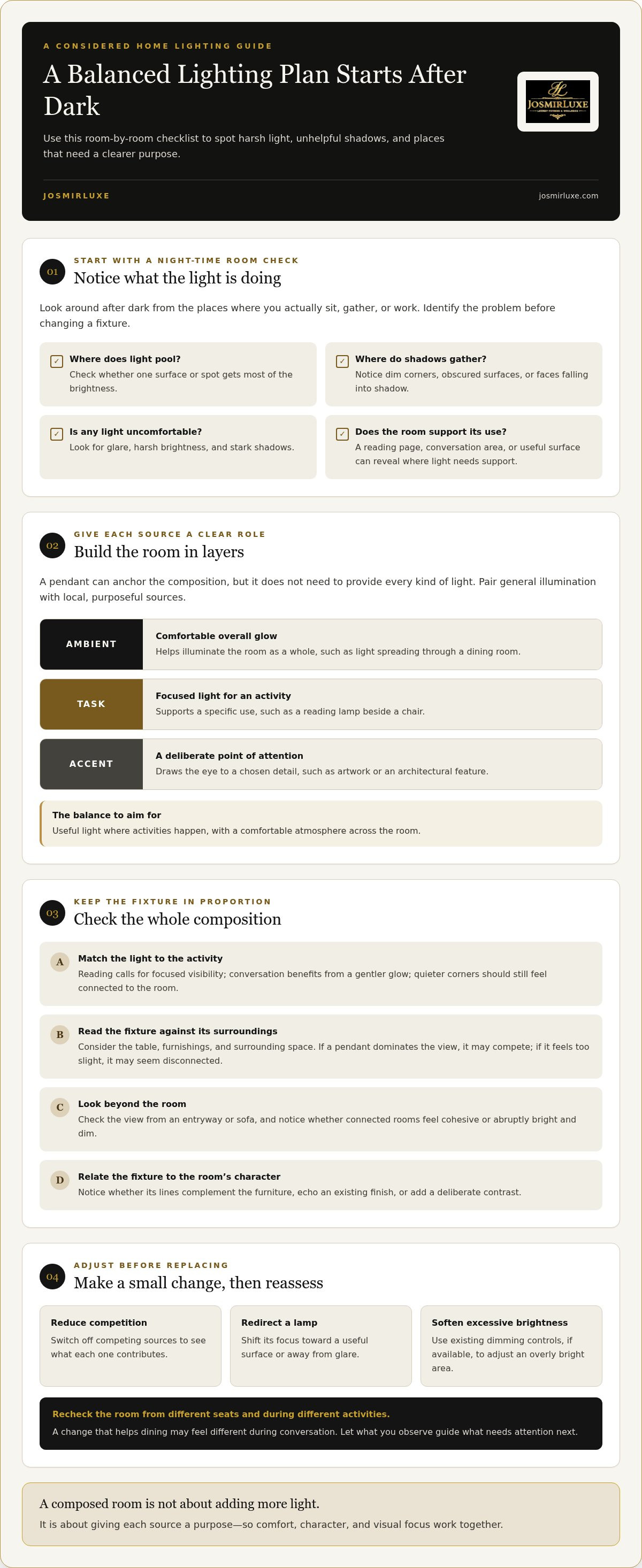
To correct common lighting mistakes in luxury homes, begin by observing the room after dark. Notice where light pools, where shadows interrupt a useful surface, and where brightness causes glare. Then give each existing source a purpose. This quick assessment can show whether the room needs more focused light, softer general illumination, or a clearer point of visual interest.
A balanced room pairs general illumination with purposeful local light. The result feels comfortable as a whole and considered in every corner.
Build a layered lighting plan around the way the room is used
Ambient light provides a comfortable overall glow, such as light that spreads through a dining room. Task light supports a particular activity, like a reading lamp beside a chair. Accent light draws attention to a chosen detail, such as artwork or an architectural feature. Together, these layers make a space more adaptable without asking one fixture to do everything.
In a dining area, a pendant can establish the table as the focal point, while softer sources elsewhere keep the surrounding room from receding into darkness. The pendant feels intentional when it belongs to a broader composition rather than carrying the entire atmosphere alone. Explore modern pendant lighting as one considered element in that balance.
Before replacing a fixture, adjust what is already there. Switch off competing sources, redirect a lamp, or use existing dimming controls to soften an overly bright area. Reassess the room from different seats and during different activities, from dining to conversation. These small changes can clarify what is working and what needs attention, helping preserve the room’s character while making its light feel more composed.
Create a more cohesive luxury-home lighting scheme
A cohesive scheme begins with how rooms relate to one another. Notice the view from an entryway, the sightline from a sofa, and the transition between connected spaces. If one room glows brightly while the next falls into shadow, the shift can feel abrupt. Repeating a subtle quality, such as a similar warmth or visual rhythm, helps connect the home without making every room identical.
Consider what deserves attention in each view. A dining table, artwork, or architectural detail may serve as a focal point, while nearby furnishings and finishes shape how the light is experienced. Looking at the whole view can reveal common lighting mistakes in luxury homes, such as choosing a prominent fixture without considering the room around it.
Make lighting feel connected to the room, not added as an afterthought
Think about the room’s materials and mood before adding another fixture. A pendant above a dining table can create a clear point of focus. Its form and visual presence should feel in proportion to the table, furnishings, and surrounding space. If it dominates the view, it may compete with the room. If it feels too slight, it may seem disconnected. Let the overall composition guide the choice rather than relying on size alone.
In a furnished home, small decisions can bring the scheme into focus. Consider whether a fixture complements the lines of the furniture, echoes a finish already present, or introduces a deliberate contrast. Then look beyond the room: does its light sit comfortably beside the adjoining space, or create an unintended break? Explore modern pendant lighting as one design element within a considered whole.
Thoughtful lighting is not about adding more. It is about choosing each source with care, so comfort, character, and visual focus feel naturally in balance.
Shape a more inviting atmosphere at home
The character of a room is felt in its quieter moments: settling in after the day, welcoming friends, or moving easily from one space to another. Avoiding common lighting mistakes in luxury homes is less about chasing a flawless look and more about noticing how light supports the life unfolding there.
Start with one intentional change. Reconsider a source that feels too dominant, or identify a place where a thoughtful fixture could bring greater focus. JOSMIRLUXE brings together modern pendant lighting and designer furnishings for refined interiors, with pieces that can become part of a home’s wider visual story.
Explore modern pendant lighting and consider how a carefully chosen detail might complement your space. With a little attention, lighting can make home feel more balanced, comfortable, and entirely your own.
Frequently Asked Questions
How high should a pendant light hang over a dining table?
A common starting point is 30 to 36 inches from the tabletop to the bottom of the pendant. Adjust for ceiling height, fixture scale, and sightlines. Faces should remain visible across the table, and the fixture should not interrupt conversation. For a large pendant or a high ceiling, assess the position from seated eye level before settling on its final height.
What is the best way to light artwork without glare?
Position the light so it illuminates the artwork without reflecting directly toward the viewer. Stand in the usual viewing spot and adjust the angle until bright reflections are minimized. This matters especially with glass or glossy surfaces, where a well-aimed light can reveal color and detail without making the artwork difficult to see.
Can dimmers be used with LED lights?
Yes, if the LED bulb or fixture is dimmable and compatible with the dimmer. Mismatched components can cause flickering, buzzing, or an uneven dimming range. When changing bulbs in an existing fixture, check the bulb and dimmer guidance together, then test the light at several settings to find a comfortable level for the room.
Is it okay to mix different metal finishes in a luxury home?
Yes. Mixed finishes can feel intentional when one finish leads and the others appear in considered accents, such as a brass pendant paired with darker cabinet hardware. Look at the undertones as well as the finishes themselves. Warm metals often sit naturally beside warm wood, while cooler tones can complement stone. Repeating a finish elsewhere helps the combination feel connected.